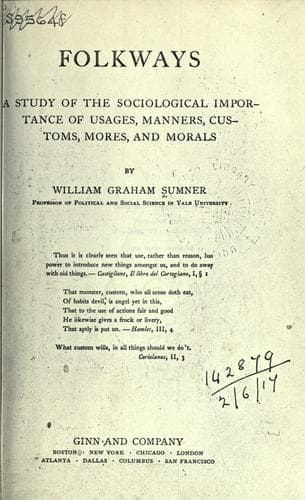
Folkways: A Study of the Sociological Importance of Usages, Manners, Customs, Mores, and MoralsSumner, William Graham
General
Folkways: A Study of the Sociological Importance of Usages, Manners, Customs, Mores, and Morals
Sumner, William Graham
Manners and customs
+180. The value of analysis and verification as tests.+ In all the cases
of the use of catchwords, watchwords, and phrases, the stereotyped forms
of language seem to convey thought, especially ascertained truth, and
they do it in a way to preclude verification. It is absolutely essential
to correct thinking and successful discussion to reject stereotyped
forms, and to insist on analysis and verification. Evidently all forms
of suggestion tend to create an atmosphere of delusion. Pathos increases
the atmosphere of delusion. It introduces elements which corrupt the
judgment. In effect, it continues the old notion that there are edifying
falsehoods and useful deceits. The masses always infuse a large
emotional element into all their likes and dislikes, approval and
disapproval. Hence, in time, they surround what they accept with pathos
which it is hard to break through.
+181. Humanity.+ The standard of humanity or of decent behavior,
especially towards the weak or those persons who may be at one's mercy,
or animals, is entirely in the mores of the group and time. To the
Gauchos of Uruguay "inhumanity and love of bloodshed become second
nature." Their customs of treating beasts habituate them to bloodshed.
"They are callous to the sight of blood and suffering and come to
positively enjoy it." They have no affection for their horses and dogs.
They murder for plunder.[374] It is very rarely that we meet with such a
description as that of any people. Polynesians were bloodthirsty and
cruel, perhaps because they had no chase of wild animals in which to
expend their energies.[375] North American Indians could invent
frightful tortures, but they were not bloodthirsty. They were not
humane. Suffering did not revolt them. Schomburgk[376] tells a story of
an Indian who became enraged at his wife because she groaned with
toothache. He cut down her hammock and caused her to fall so that she
suffered a dislocation of the arm. A European witness went to the chief
with a report and remonstrance, but the chief was astonished that any
one should take any notice of such an incident. The Assyrians cut in
stone representations of flaying, impaling, etc., and of a king with his
own royal hands putting out the eyes of prisoners. The Egyptians
represented kings slaying men (national enemies) in masses. The Romans
enjoyed bloodshed and the sight of suffering.[377] The Middle Ages
reveled in cruelty to men and beasts. It is in the Middle Ages that we
could find the nearest parallels to the Gauchos above. None of these
people felt that repulsive revolt of the whole nature at inhumanity
which characterizes modern cultivated people. The horrors have all
receded out of our experience, and almost out of our knowledge. The line
of familiarity is set far off. Therefore a little thing in the way of
inhumanity is strange and exerts its full repulsive effect. Things
happen, however, which show us that human nature is not changed, and
Public-domain text, read in full here on John Shaqi.
Reviews
Reviews
No reviews yet
Be the first to share your thoughts on this work.
Elsewhere in the archive
Join the Discussion
Join the discussion
Sign in to leave a comment or review.
Sign InorCreate an account