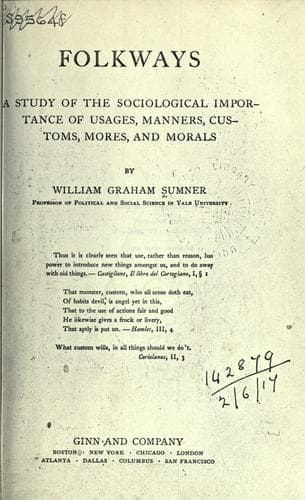
Folkways: A Study of the Sociological Importance of Usages, Manners, Customs, Mores, and MoralsSumner, William Graham
General
Folkways: A Study of the Sociological Importance of Usages, Manners, Customs, Mores, and Morals
Sumner, William Graham
Manners and customs
+178. Pathos.+ Suggestion is powerfully aided by _pathos_, in the
original Greek sense of the word. Pathos is the glamour of sentiment
which grows up around the pet notion of an age and people, and which
protects it from criticism. The Greeks, in the fourth century before
Christ, cherished pathos in regard to tyrannicide. Tyrants were bosses,
produced by democracy in towns, but hated by democrats. Tyrannicides
were surrounded with a halo of heroism and popular admiration.[373]
Something of the same sentiment was revived in the sixteenth century,
when it appeared that a tyrant was any ruler whose politics one did not
like. It cost several rulers their lives. Pathos was a large element in
the notions of woman and knighthood (twelfth and thirteenth centuries),
of the church (thirteenth century), of the Holy Sepulcher (eleventh and
twelfth centuries). In the thirteenth century there was a large element
of pathos in the glorification of poverty. A great deal of pathos has
been expended on the history and institutions of Greece and Rome in
modern times. Classical studies still depend largely on it for their
prestige. There is a pathos of democracy in the United States. In all
English-speaking countries marriage is an object of pathos. The pathos
is cultivated by poetry and novels. Humanitarianism is nourished by
pathos and it stimulates pathos. The "poor" and the "laborers" are
objects of pathos, on account of which these terms, in literature, refer
to a conventional and unreal concept. Consequently there is no honest
discussion of any topic which concerns the poor or laborers. Some people
make opposition to alcohol an object of pathos.
+179. Pathos is unfavorable to truth.+ Whenever pathos is in play the
subject is privileged. It is regarded with a kind of affection, and is
protected from severe examination. It is made holy or sacred. The thing
is cherished with such a preestablished preference and faith that it is
thought wrong to verify it. Pathos, therefore, is unfavorable to truth.
It has always been an element in religion. It is an element now in
patriotism, and in regard to the history of one's own country. The
coercion of pathos on the individual comes in popular disapproval of
truth-telling about the matter in question. The toleration for forgery
and fraud in the Christian church until modern times, which to modern
people seems so shocking and inexplicable, was chiefly due to pathos
about religion and the church. If a forgery would help the church or
religion, any one who opposed it would seem to be an enemy of religion
and the church and willing to violate the pathos which surrounded them.
Public-domain text, read in full here on John Shaqi.
Reviews
Reviews
No reviews yet
Be the first to share your thoughts on this work.
Elsewhere in the archive
Join the Discussion
Join the discussion
Sign in to leave a comment or review.
Sign InorCreate an account