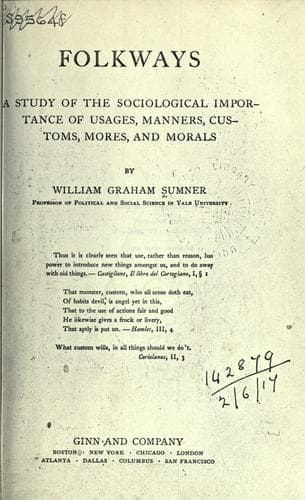
Folkways: A Study of the Sociological Importance of Usages, Manners, Customs, Mores, and MoralsSumner, William Graham
General
Folkways: A Study of the Sociological Importance of Usages, Manners, Customs, Mores, and Morals
Sumner, William Graham
Manners and customs
+183. Aristocracies.+ All aristocracies are groups of those who are
distinguished, at the time, for the possession of those things which are
admired or approved, and which give superiority in the struggle for
existence or in social power. In the higher civilization, until modern
times, the possession of land was the only social power which would
raise a man above sordid cares and enable him to plan his life as he
chose. By talent an income could be won which would give the same
advantage, but not with the same security of permanence and
independence. The fields for talent were war, civil administration, and
religion, the last including all mental activity. Men of talent had to
win their place by craft and charlatanism (sorcery, astrology,
therapeutics). Their position never was independent, except in church
establishments. They had to win recognition from warriors and
landowners, and they became comrades and allies of the latter. Merchants
and bankers were the aristocracy at Carthage, Venice, Florence, and
Genoa, and in the Hansa. Talented military men were aristocrats under
Napoleon, courtiers were such under Louis XIV, and ecclesiastics at
Rome. Since the fourteenth century capital has become a new and the
greatest and indispensable social power. Those who, at any time, have
the then most important social power in their hands are courted and
flattered, envied and served, by the rest. They make an aristocracy. The
aristocrats are the distinguished ones, and their existence and
recognition give direction to social ambition. Of course this acts
selectively to call out what is most advantageous and most valued in the
society.
+184.+ There are a number of mass phenomena which are on a lower grade
than the mores, lacking the elements of truth and right with respect to
welfare, which illustrate still further and more obviously the coercion
of all mass movements over the individual. These are fashion, poses,
fads, and affectations.
Public-domain text, read in full here on John Shaqi.
Reviews
Reviews
No reviews yet
Be the first to share your thoughts on this work.
Elsewhere in the archive
Join the Discussion
Join the discussion
Sign in to leave a comment or review.
Sign InorCreate an account