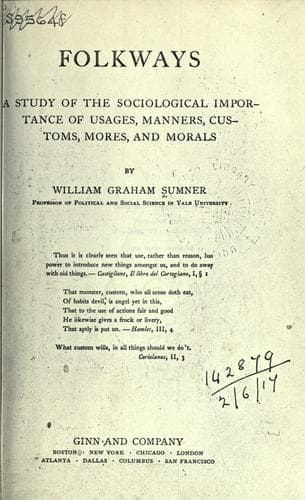
Folkways: A Study of the Sociological Importance of Usages, Manners, Customs, Mores, and MoralsSumner, William Graham
General
Folkways: A Study of the Sociological Importance of Usages, Manners, Customs, Mores, and Morals
Sumner, William Graham
Manners and customs
+185. Fashion.+ Fashion in dress has covered both absurdities and
indecencies with the aegis of custom. From the beginning of the
fourteenth century laws appear against indecent dress. What nobles
invented, generally in order to give especial zest to the costume of a
special occasion, that burghers and later peasants imitated and made
common.[378] In the fifteenth century the man's hose fitted the legs and
hips tightly. The latchet was of a different color, and was decorated
and stuffed as if to exaggerate still further the indecent obtrusiveness
of it.[379] Schultz[380] says that the pictures which we have do not
show the full indecency of the dress against which the clergy and
moralists of the fifteenth century uttered denunciations, but only those
forms which were considered decent, that is, those which were within the
limits which custom at the time had established. At the same time women
began to uncover the neck and bosom. The extent to which this may be
carried is always controlled by fashion and the mores. Puritans and
Quakers attempted to restrict it entirely, and to so construct the
dress, by a neckerchief or attachment to the bodice, that the shape of
the bust should be entirely concealed. The mores rejected this rule as
excessive. In spite of all the eloquence of the moral preachers, that
form of dress which shows neck and bosom has become established, only
that it is specialized for full dress and covered by conventionalization.
+186. Conventionalization.+ Conventionalization also comes into play to
cover the dress of the ballet or burlesque opera and the bathing dress.
Conventionalization always includes strict specification and limits of
time, place, and occasion, beyond which the same dress would become
vicious. Amongst Moslems and Orientals this conventionalization as to
dress has never been introduced. We are familiar with the fact that when
a fashion has been introduced and has become common our eye is formed to
it, and no one looks "right" or stylish who does not conform to it. We
also know that after the fashion has changed things in the discarded
fashion look dowdy and rustic. No one can resist these impressions, try
as he may. This fact, in the experience of everybody, gives us an
example of the power of current custom over the individual. While a
fashion reigns its tendency is to greater and greater extravagance in
order to produce the desired and admired effect. Then the toleration for
any questionable element in the fashion is extended and the extension is
unnoticed. If a woman of 1860, in the dress of her time, were to meet a
woman of 1906, in the dress of her time, each would be amazed at the
indecency of the dress of the other. No dress ever was more, or more
justly, denounced for ugliness, inconvenience, and indecency than the
crinoline, but all the women from 1855 to 1865, including some of the
sweetest who ever lived, wore it. No inference whatever as to their
taste or character would be justified.
Public-domain text, read in full here on John Shaqi.
Reviews
Reviews
No reviews yet
Be the first to share your thoughts on this work.
Elsewhere in the archive
Join the Discussion
Join the discussion
Sign in to leave a comment or review.
Sign InorCreate an account