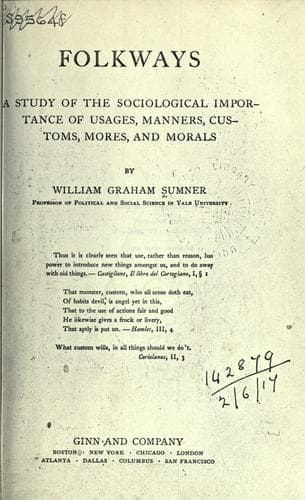
Folkways: A Study of the Sociological Importance of Usages, Manners, Customs, Mores, and MoralsSumner, William Graham
General
Folkways: A Study of the Sociological Importance of Usages, Manners, Customs, Mores, and Morals
Sumner, William Graham
Manners and customs
+188. Fashion in ethnography.+ The Carib women in Surinam think that
large calves of the leg are a beauty. Therefore they bind the leg above
the ankle to make the calves larger. They begin the treatment on
children.[385] Some Australian mothers press down their babies' noses.
"They laugh at the sharp noses of Europeans, and call them tomahawk
noses, preferring their own style."[386] The presence of two races side
by side calls attention to the characteristic differences. Race vanity
then produces an effort to emphasize the race characteristics. Samoan
mothers want the noses and foreheads of their babies to be flat, and
they squeeze them with their hands accordingly.[387] The "Papuan ideal
of female beauty has a big nose, big breasts, and a dark-brown, smooth
skin."[388] To-day the Papuans all smoke white clay pipes. Four weeks
later no one will smoke a white pipe. All want brown ones. Still four
weeks later no one wants any pipe at all. All run around with red
umbrellas.[389] On the Solomon Islands sometimes they want plain pipes;
then again, pipes with a ship or anchor carved on them; again, pipes
with a knob. Women wear great weights of metal as rings for
ornament.[390] The Galla women wear rings to the weight of four or six
pounds.[391] Tylor[392] says that an African belle wears big copper
rings which become hot in the sun, so that the lady has to have an
attendant, whose duty it is to cool them down by wetting them. The queen
of the Wavunias on the Congo wore a brass collar around her neck, which
weighed from sixteen to twenty pounds. She had to lie down once in a
while to rest.[393] The Herero wear iron which in the dry climate
retains luster. The women wear bracelets and leglets, and iron beads
from the size of a pea to that of a potato. They carry weights up to
thirty-five pounds and are forced to walk with a slow, dragging step
which is considered aristocratic. Iron is rare and worth more than
silver.[394] Livingstone says that in Balonda poorer people imitate the
step of those who carry big weights of ornament, although they are
wearing but a few ounces.[395] Some women of the Dinka carry fifty
pounds of iron. The rings on legs and arms clank like the fetters of
slaves. The men wear massive ivory rings on the upper arm. The rich
cover the whole arm. The men also wear leather bracelets and
necklaces.[396] In Behar, Hindostan, the women wear brass rings on their
legs. "One of these is heavy, nearly a foot broad, and serrated all
around the edges. It can only be put on the legs by a blacksmith, who
fits it on the legs of the women with his hammer, while they writhe upon
the ground in pain." Women of the milkman caste wear bangles of bell
metal, often up to the elbow. "The greater the number of bangles, the
more beautiful the wearer is considered."[397] The satirist could easily
show that all these details are shown now in our fashions.
Public-domain text, read in full here on John Shaqi.
Reviews
Reviews
No reviews yet
Be the first to share your thoughts on this work.
Elsewhere in the archive
Join the Discussion
Join the discussion
Sign in to leave a comment or review.
Sign InorCreate an account