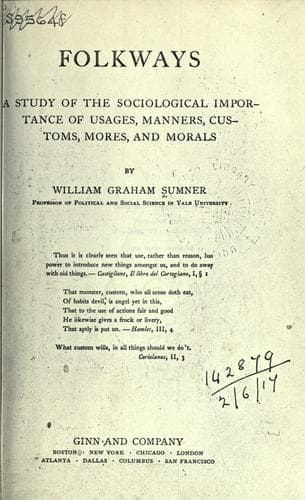
Folkways: A Study of the Sociological Importance of Usages, Manners, Customs, Mores, and MoralsSumner, William Graham
General
Folkways: A Study of the Sociological Importance of Usages, Manners, Customs, Mores, and Morals
Sumner, William Graham
Manners and customs
+189. Ideals of beauty.+ In Melanesia a girdle ten centimeters wide is
worn, drawn as tight as possible. One cut from the body of a man
twenty-seven years old measured only sixty-five centimeters.[398] The
women of the Barito valley wear the _sarong_ around the thighs so tight
that it restricts the steps and produces a mincing gait which they think
beautiful.[399] The Rukuyenn of Guiana have an ideal of female beauty
which is marked by a large abdomen. They wind the abdomen with many
girdles to make it appear large. "The women of the Payaguas, in
Paraguay, from youth up, elongate the breasts, and they continue this
after they are mothers by means of bandages."[400] The southern Arabs
drop hot grease from a candle on a bride's fingers, and then plaster the
fingers with henna. Then the grease is taken off, and light-colored
spots (if possible, regular) are left where it was, while the rest of
the skin is colored brown by the henna. They put on the bride seventeen
garments, a silk one and a muslin one alternately; then a mantle over
all, and a rug on the mantle, and all possible ornaments.[401] Flinders
Petrie thinks that we must recognize a principle of "racial taste,"
"which belongs to each people as much as their language, which may be
borrowed like languages from one race by another, but which survives
changes and long eclipses even more than language."[402] The cases given
show that ideals of beauty are somehow formed, which call for a
deformation of the human body. The foreheads are flattened, the lips
enlarged, the ears drawn down, the skull forced into a sugar-loaf shape,
the nose flattened, etc., to try to reach a form approved by fashion.
There is an ideal of beauty behind the fashion, a selected type of
superiority, which must be assumed as the purpose of the fashion.
Public-domain text, read in full here on John Shaqi.
Reviews
Reviews
No reviews yet
Be the first to share your thoughts on this work.
Elsewhere in the archive
Join the Discussion
Join the discussion
Sign in to leave a comment or review.
Sign InorCreate an account