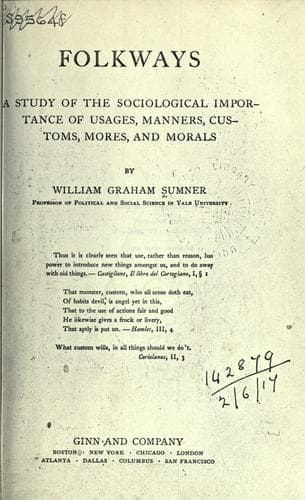
Folkways: A Study of the Sociological Importance of Usages, Manners, Customs, Mores, and MoralsSumner, William Graham
General
Folkways: A Study of the Sociological Importance of Usages, Manners, Customs, Mores, and Morals
Sumner, William Graham
Manners and customs
+197. Slang and expletives.+ Slang and expletives are fashions in
language. Expletives are of all grades from simple interjections to the
strongest profanity. Many expletives are ancient religious formulas of
objurgation, obsecration, asseveration, anathema, etc. They express a
desire to curse or bless, invite or repel. Where the original sense is
lost they sink into interjections, the whole sense of which is in the
accent. Their use rises and falls with fashion in nations, classes,
groups, and families, and it controls the habits of individuals. Whether
certain persons use a pious dialect, a learned (pedantic) dialect, a
gambler's slang, a phraseology of excessive adjectives and silly
expletives, or profane expressions, oaths, and phrases which abuse
sacred things, depends on birth and training. In this sense each dialect
is the language for each group and corresponds to the mores of the
group. There may be some psychology of expletives,[410] but they seem to
be accounted for, like slang, by the expediency of expression, which is
the purpose of all language. There is a need for expression which will
win attention and impress the memory. A strong expletive shocks an
opponent, or it is an instinctive reaction on a situation which
threatens the well-being of the speaker. It is a vent to emotion which
gives relief from it when other relief is not possible. This last is one
of the chief useful reasons for expletives. However, even then they are
a vicious habit, for stronger and stronger expressions are required to
win the same subjective effects. Old expressions lose force. Slang is
the new coinage. The mintage is often graphic and droll; it is also
often stupid and vulgar. A selection goes on. Some of it is rejected and
some enters into the language. Expletives also go out of fashion. The
strain for effect can be satisfied only by constantly greater and
greater excess. It becomes a bad personal habit to use grotesque and
extravagant expressions. Slang and expletives destroy the power of clear
and cogent expression in speech or writing; and they must affect powers
of thinking. Although slang is a new coinage which reinvigorates the
language, the fashion of slang and expletives must be rated, like the
fashion of using tobacco and alcohol, as at best a form of play, a habit
and custom which springs from no need and conduces to no interest. The
acts result in an idle satisfaction of the doer, and the good or ill
effects all fall within his own organism. The prevalence of such
fashions in a society becomes a fact of its mores, for there will be
rational effects on interests. The selective effect of them is in the
resistance to the fashions or subjection to them. They are only to a
limited extent enforced by social sanctions. There is personal liberty
in regard to them. Resistance depends on independent judgment and
self-control, and produces independence and self-control; that is, it
affects character.
Public-domain text, read in full here on John Shaqi.
Reviews
Reviews
No reviews yet
Be the first to share your thoughts on this work.
Elsewhere in the archive
Join the Discussion
Join the discussion
Sign in to leave a comment or review.
Sign InorCreate an account