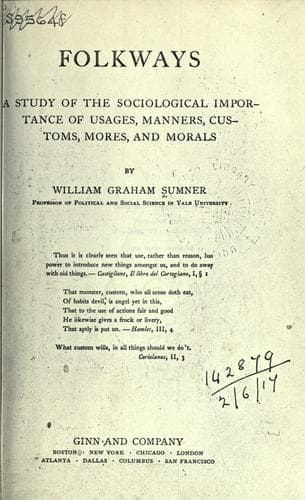
Folkways: A Study of the Sociological Importance of Usages, Manners, Customs, Mores, and MoralsSumner, William Graham
General
Folkways: A Study of the Sociological Importance of Usages, Manners, Customs, Mores, and Morals
Sumner, William Graham
Manners and customs
They seem to have been derived from the fathers of the
fourth and fifth centuries, but they offer an example of borrowed and
adopted ideals which were fully incorporated in the popular mores. The
age accepted ascetic standards of goodness and character. The religious
classes and the lay classes did not fall under the same standards of
conduct and duty. It was the business of the former to live by the full
standard. All classes, however, accepted the standards as valid, and the
layman conformed to them at times, or as far as worldly life would
permit. Elizabeth of Thuringia seems to be the ideal of the married
woman, but her saintliness interfered with her other duties, and even
her own time does not seem to have been sure in its judgment of her.
That she was flogged is a fact which has many relations to her character
and her age.[428] All admired men who practiced asceticism and
self-discipline. The types of the age were knightliness and saintliness.
They were both highly elaborated. The knightly type began to develop in
the time of Charlemagne and ran through the crusades. It contained
grotesque and absurd elements. The story of the crusades is a criticism
upon it. The knight was a fantastic person, who might do isolated deeds
of valor, but who could not make a plan, work persistently to a purpose,
cooperate with others, or either enforce or submit to discipline. Both
the knight and the saint were ideal types which exerted a controlling
power of selection through centuries.
+207. The standard type of man.+ Is the ideal of the man-as-he-should-be
to be found, for us, in the "common man," or in the highest product of
our culture? That is a most vital question for any society. It includes
the question whether the society has a discord in itself as to its own
ideal of the type of men it wants to produce. In the upper strata of the
masses, amongst the educated, industrious, sober-minded people of good
incomes, there exists the best family life. The children live constantly
with their parents, and the latter watch over the health, manners, and
morals of the children unceasingly from birth to maturity. The same
parents make great sacrifices for the education of their children,
although the class, as a class, has means to secure what is necessary
without hard sacrifice. The point is that they value education highly
and get it. We also multiply educational institutions. We feel sure that
all this is good work. The churches and all good literature constantly
inculcate good manners and morals according to the standards in the
present mores. Here is a set of objects to be prized and worked for in
families, schools, self-education, literature, and art, which go to the
production of a type of men as the highest product of our civilization.
Then suddenly we are told that the common man is wise beyond all the
philosophers. The man on the curbstone is the arbiter of our destinies,
and the standard man. "Culture" is derided and sneered at. This latter
Public-domain text, read in full here on John Shaqi.
Reviews
Reviews
No reviews yet
Be the first to share your thoughts on this work.
Elsewhere in the archive
Join the Discussion
Join the discussion
Sign in to leave a comment or review.
Sign InorCreate an account