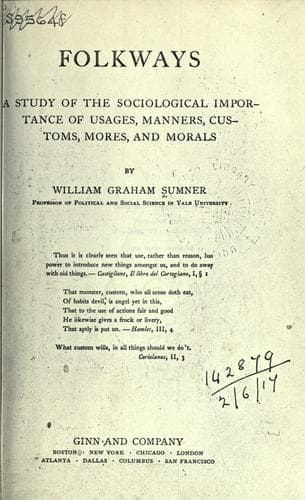
Folkways: A Study of the Sociological Importance of Usages, Manners, Customs, Mores, and MoralsSumner, William Graham
General
Folkways: A Study of the Sociological Importance of Usages, Manners, Customs, Mores, and Morals
Sumner, William Graham
Manners and customs
view has great popularity. It brings up a serious question: whether we
are spoiling our children by educating them. Are we spoiling them for
political power? Are we putting them under disabilities for public
influence? It is related of an English statesman, that when asked by an
American mother whether she should send her son to Oxford, he replied:
"Why send him to Oxford? Send him to Washington, where he will learn
democracy. That is what he will need to know." Certainly it behooves us
to know whether we are spoiling our sons by sending them to the
universities, and whether we ought not rather to send them to Tammany
Hall. Either on one side or the other there is a great mass of empty
phrases and false but inflated rhetoric.
+208. Who does the thinking?+ The notion that "the group thinks"
deserves to be put by the side of the great freaks of philosophy which
have been put forth from age to age. Only the elite of any society, in
any age, think, and the world's thinking is carried on by them by the
transplanting of ideas from mind to mind, under the stress and strain of
clashing argument and tugging debate. If the group thinks, then thought
costs nothing, but in truth thought costs beyond everything else, for
thousands search and talk while only one finds; when he finds something,
a step is won and all begins over again. If this is so, it ought to be
universally known and recognized. All the mores would then conform to
it.
+209. The gentleman.+ In modern English-speaking society the "gentleman"
is the name for the man-as-he-should-be. The type is not fixed and the
definition is not established. It is a collective and social ideal.
Gentlemen are a group in society who have selected a code and standard
of conduct as most conducive to prosperous and pleasant social
relations. Therefore manners are an essential element in the type. A
gentleman is one who has been educated to conform to the type, and that
he has the _cachet_ is indicated by his admission to the group. Novels
develop and transmit the ideal; clubs are the tribunal of it. It is a
floating notion which varies with the mores. The modern reader finds
very few cases in Greek literature of what he can recognize as
gentlemen. Orestes in the _Electra_ of Euripides opens the discussion of
what makes the worth of a man, but after saying that it is not wealth or
poverty, and not valor in war, he flinches the question and says that it
is better to leave it untouched. The peasant, married to Electra,
certainly acts the gentleman. He also says of Orestes and Pylades, that
if they really are as noble as they seem, they will be as well satisfied
with humble fare as with grand fare. A gentleman of a century ago would
not be approved now. A gentleman of to-day in the society of a century
ago would be thought to have rowdy manners. Artificial manners are not
in the taste of our time; athletics are. The "gentleman" always tends to
an arbitrary definition. It appears now that he must have some skill at
Public-domain text, read in full here on John Shaqi.
Reviews
Reviews
No reviews yet
Be the first to share your thoughts on this work.
Elsewhere in the archive
Join the Discussion
Join the discussion
Sign in to leave a comment or review.
Sign InorCreate an account