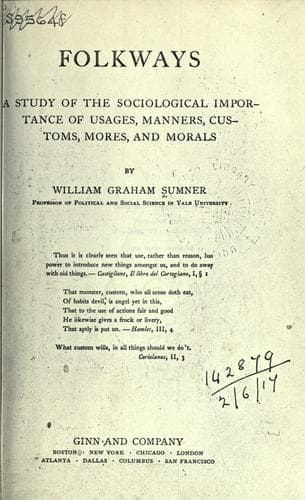
Folkways: A Study of the Sociological Importance of Usages, Manners, Customs, Mores, and Morals — John Shaqi
Folkways: A Study of the Sociological Importance of Usages, Manners, Customs, Mores, and MoralsSumner, William Graham
General
Folkways: A Study of the Sociological Importance of Usages, Manners, Customs, Mores, and Morals
Sumner, William Graham
Manners and customs
In 1899 I began to write out a text-book of sociology from material
which I had used in lectures during the previous ten or fifteen years.
At a certain point in that undertaking I found that I wanted to
introduce my own treatment of the "mores." I could not refer to it
anywhere in print, and I could not do justice to it in a chapter of
another book. I therefore turned aside to write a treatise on the
"Folkways," which I now offer. For definitions of "folkways" and "mores"
see secs. 1, 2, 34, 39, 43, and 66. I formed the word "folkways" on the
analogy of words already in use in sociology. I also took up again the
Latin word "mores" as the best I could find for my purpose. I mean by it
the popular usages and traditions, when they include a judgment that
they are conducive to societal welfare, and when they exert a coercion
on the individual to conform to them, although they are not coordinated
by any authority (cf. sec. 42). I have also tried to bring the word
"Ethos" into familiarity again (secs. 76, 79). "Ethica," or "Ethology,"
or "The Mores" seemed good titles for the book (secs. 42, 43), but
Ethics is already employed otherwise, and the other words were very
unfamiliar. Perhaps "folkways" is not less unfamiliar, but its meaning
is more obvious. I must add that if any one is liable to be shocked by
_any_ folkways, he ought not to read about folkways at all. "Nature her
custom holds, let shame say what it will" (_Hamlet_, IV, 7, _ad fin._).
I have tried to treat all folkways, including those which are most
opposite to our own, with truthfulness, but with dignity and due respect
to our own conventions.
Chapter I contains elaborate definitions and expositions of the folkways
and the mores, with an analysis of their play in human society. Chapter
II shows the bearing of the folkways on human interests, and the way in
which they act or are acted on. The thesis which is expounded in these
two chapters is: that the folkways are habits of the individual and
customs of the society which arise from efforts to satisfy needs; they
are intertwined with goblinism and demonism and primitive notions of
luck (sec. 6), and so they win traditional authority. Then they become
regulative for succeeding generations and take on the character of a
social force. They arise no one knows whence or how. They grow as if by
the play of internal life energy. They can be modified, but only to a
limited extent, by the purposeful efforts of men. In time they lose
power, decline, and die, or are transformed. While they are in vigor
they very largely control individual and social undertakings, and they
produce and nourish ideas of world philosophy and life policy. Yet they
are not organic or material. They belong to a superorganic system of
relations, conventions, and institutional arrangements. The study of
them is called for by their _social_ character, by virtue of which they
are leading factors in the science of society.
Public-domain text, read in full here on John Shaqi.
Reviews
Reviews
No reviews yet
Be the first to share your thoughts on this work.
Join the Discussion
Join the discussion
Sign in to leave a comment or review.
Sign InorCreate an account