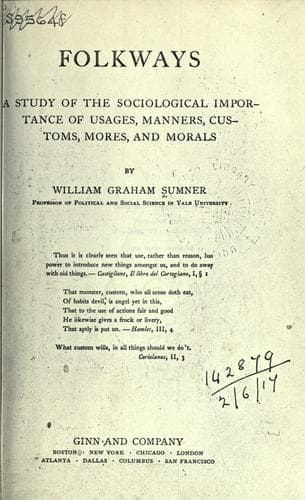
Folkways: A Study of the Sociological Importance of Usages, Manners, Customs, Mores, and MoralsSumner, William Graham
General
Folkways: A Study of the Sociological Importance of Usages, Manners, Customs, Mores, and Morals
Sumner, William Graham
Manners and customs
+220. Delusions.+ Of popular delusions one of the most striking and
recurrent examples is the belief that new and despised religious sects,
which are forced to meet in private, practice obscene and abominable
orgies. The early Christians were accused of such rites, and they
charged dissenting sects with the same.[461] The Manichaeans, Waldenses,
Huguenots, Puritans, Luciferans, Brothers of the Free Spirit, and so on
through the whole list of heretical sects, have been so charged. Lea, in
his History of the Inquisition, mentions over a dozen cases of such
charges, some of which were true. Nowadays the same assertions are made
against freemasons by Roman Catholics.[462] Jews are believed by the
peasants of eastern Europe to practice abominable rites in secret. The
idea that secret sects use the blood of people not of their sect,
especially of babies, in base rites is only a variant of the broad idea
about secret rites. It is sometimes said that the charges were invented
to make sects unpopular, but it is more probable that they arose from
the secrecy of the meetings only. Christians are so charged now in
China.[463] The story of the discovery of such misbehavior always
contains the same explanation--a husband followed his wife to the
meeting and saw the proceedings.[464]
+221. Manias need suggestion.+ Manias and delusions are like fashions
and fads in that they always seem to need a suggestion from some outside
source, and often it is impossible to find such a source. A strong
popular belief, like the belief in Satan and demons, furnishes a ground
for a general disposition to hold some other people responsible for all
the ills which befall one's self. Then the disposition to act cruelly
against the suspected person arises to a mental disease, and by
cooperation of others under the same aberration makes a mania.[465] The
explanation lies in autosuggestion or fixed ideas with the development
loosely ranged under hysteria, which is the contagious form of nervous
affection. The term "epidemic" can be applied only figuratively. "Mental
disease occurs only on the ground of a specific constitutional and
generally hereditary predisposition. It cannot therefore be spread
epidemically, any more than diabetes or gout."[466] The epidemic element
is due to hysterical imitation. In like manner, epidemics or manias of
suicide occur by imitation, e.g. amongst the Circumcellions, a
subdivision of the Donatists, in Africa, in the middle of the fourth
century A.D.[467] Cognate with this was the mania for martyrdom which it
required all the authority of the church to restrain.[468] Josephus[469]
says of the Galileans, followers of Judas of Galilee, that they were
famous for their indifference to death. Convents were often seats of
frightful epidemics of hysteria. The accepted religious notions
furnished a fruitful soil for it. To be possessed by devils was a
distinction, and vanity was drawn into play.[470] Autosuggestion was
Public-domain text, read in full here on John Shaqi.
Reviews
Reviews
No reviews yet
Be the first to share your thoughts on this work.
Elsewhere in the archive
Join the Discussion
Join the discussion
Sign in to leave a comment or review.
Sign InorCreate an account