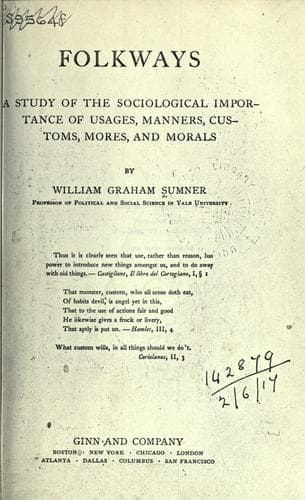
Folkways: A Study of the Sociological Importance of Usages, Manners, Customs, Mores, and MoralsSumner, William Graham
General
Folkways: A Study of the Sociological Importance of Usages, Manners, Customs, Mores, and Morals
Sumner, William Graham
Manners and customs
due to an ancient grudge against them as a papal police founded
in the interests of orthodoxy, but the chief point aimed at is
the mixture of hypocrisy with immorality, which rendered them
odious to all classes of society."[459] "In general the
Franciscans seem to us far less orthodox than the Dominicans.
They issued from a popular movement which was irregular,
unecclesiastical, very little conformed to the ideas of the
hierarchy about discipline." "The followers of St. Francis
continued to contain ardent-minded men who maintained that the
Franciscan reform had not produced all its due results; that that
reform was superior to popes and to the dispensations issued at
Rome; that the appearance of the seraphic Francis was neither
more nor less than the advent of a new Christianity and a new
Christ, like in all respects to the first, but superior to it by
poverty. Therefore all the democratic and communistic movements
of later times,--the third order of St. Francis, the Beghards,
Lollards, Bisocs, Fraticelli, Spiritual Brethren, Humiliati, and
Poor Men of Lyons [Waldenses], who were exterminated by the state
and the prisons of the Dominicans, have their origin in the old
leaven of Katharism, Joachimism, and the eternal gospel."[460]
+219. Popular mania for poverty and beggary.+ The strength of the
mendicant orders was in their popularity. They reconquered for the
church the respect of the masses. Then they became the inquisitors, and
the abusers of power for their own interests, and fell into great
disfavor. Their history shows well the course of interaction between the
masses and the rulers, and the course of institutions born in popular
mores but abused to serve private interests. The mendicant orders
furnished the army of papal absolutism. The Roman Catholic writers say
that the popes saved the world from the despotism of emperors. What is
true is that the pope and the emperor contended for the mastery, and the
masses gave it to the pope. What the popes did with it we know. That is
history. What the emperors would have done with it is matter for
conjecture. It is very probable that they would have abused the power as
badly as the popes did, but conjectural history is idle.
Public-domain text, read in full here on John Shaqi.
Reviews
Reviews
No reviews yet
Be the first to share your thoughts on this work.
Elsewhere in the archive
Join the Discussion
Join the discussion
Sign in to leave a comment or review.
Sign InorCreate an account