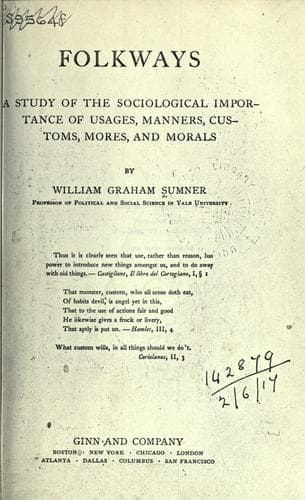
Folkways: A Study of the Sociological Importance of Usages, Manners, Customs, Mores, and MoralsSumner, William Graham
General
Folkways: A Study of the Sociological Importance of Usages, Manners, Customs, Mores, and Morals
Sumner, William Graham
Manners and customs
+228. Abelard.+ A cleric who married flinched from the standard of his
calling, in the view of the church. Hildebrand's decrees were like the
other crowning acts of great men,--they came at the culmination of a
great movement in the mores. They accorded with the will and wish of
the masses. In all ages acts are due to mixed motives, but in the Middle
Ages the good motives were kept for show and the bad ones controlled.
Clerics did not cease to have concubines until after the Council of
Trent, and the difference between law and practice (bridged over by
pecuniary penalties) called for special ethics and casuistry. The case
of Abelard (1079-1142) shows what tragedies were caused. He claimed to
be, and to some extent he was, a champion of reason and common sense,
and he was a skeptic as to the current philosophy. He was vain, weak,
and ambitious. He selected the loveliest woman he knew, and won her
love, which he used to persuade her to be his concubine, that she might
not hinder him in his career.[499] The treatment accorded to Heloise
shows that a woman could be a concubine of an ecclesiastic, but not his
wife, without condemnation. That was the allowance for human despair
under the ecclesiastical rules.[500] Thus the church first suggested
views of life and dogmas of religion, with which the masses combined
their mores and returned them to the church as a gift of societal power.
The church then formulated the mores and created disciplinary systems to
use the power and make it institutional and perpetual. Then the mores
revolted against the authority and the religion, and the ethics which it
taught. A Roman Catholic writer says that a study of the Middle Ages
will produce this result: "We shall have recognized in the church the
professional peacemaker between states and factions, as well as between
man and man, the equitable mediator between rulers and their subjects,
the consistent champion of constitutional liberty, the alleviator of the
inequalities of birth, the uninterested and industrious disseminator of
letters, the refiner of habits and manners, the well-meaning guardian of
the national wealth, health, and intellect, and the fearless censor of
public and private morality."[501] These are, indeed, the functions
which the church ought to have fulfilled, and about which ecclesiastics
said something from time to time. Also, the church did do something for
these interests when no great interest of the church was at stake on
the other side. No unbiased student of the Middle Ages has been
convinced that, in truth and justice, the work of the mediaeval church
could be thus summed up. The one consistent effort of the church was to
establish papal authority. Its greatest crime was obscurantism, which
was war on knowledge and civilization. This nothing can palliate or
offset.
Public-domain text, read in full here on John Shaqi.
Reviews
Reviews
No reviews yet
Be the first to share your thoughts on this work.
Elsewhere in the archive
Join the Discussion
Join the discussion
Sign in to leave a comment or review.
Sign InorCreate an account