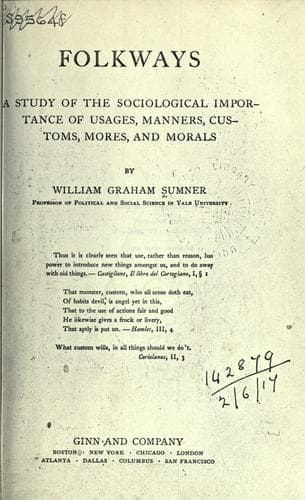
Folkways: A Study of the Sociological Importance of Usages, Manners, Customs, Mores, and MoralsSumner, William Graham
General
Folkways: A Study of the Sociological Importance of Usages, Manners, Customs, Mores, and Morals
Sumner, William Graham
Manners and customs
+229. The English church and the mores.+ The church, however, from 1000
A.D. on was a machine of societal selection, and it pursued its work,
suggesting and administering a work of that kind, grand results of which
have come down to us in the civilization we have inherited. Our work
largely consists in rational efforts to eliminate the elements which the
church introduced. In some respects the history of clerical celibacy in
England best illustrates the mores. In the sixteenth century the rule
and usage of the church had inculcated, as a deep popular prejudice, the
notion that a priest could not be married. Cranmer, in ordering a
visitation, directed investigation "whether any do contemn married
priests, and for that they be married will not receive the communion or
other sacrament at their hands."[502] This prejudice very slowly died
out, but it did die out and the popular judgment favored and required
clerical marriage. In the nineteenth century popular judgment rose in
condemnation of fox-hunting parsons, and also of pluralists, and it has
caused reforms and the disappearance of those classes.
+230. The selection of sacerdotal celibacy.+ If it had not been for
sacerdotal celibacy, there would have been ecclesiastical feudalization
and the ecclesiastical benefices would have become hereditary. The
children of priests inherited benefices and intermarried so long as the
marriage of priests was allowed. There would have been a priestly
caste.[503] The church as an institution would have been greatly
modified. The consequences we cannot imagine. If Hildebrand and the
other eleventh-century leaders foresaw the effect, it was statesmanship
on their part to establish the celibacy of the clergy. That institution
has molded the priesthood and the mores of all who have adhered to the
mediaeval church. The Latin people of southern Europe are now horrified
at the notion of a married priest. The concubine of a priest is a wicked
woman, but she is not a social abomination. All protest and resistance
seems to have passed away and, since the sixteenth century, sacerdotal
celibacy has been accepted as a feature of the Romish Church, which all
its members are expected to accept. It is a grand triumph of social
selection.
Public-domain text, read in full here on John Shaqi.
Reviews
Reviews
No reviews yet
Be the first to share your thoughts on this work.
Elsewhere in the archive
Join the Discussion
Join the discussion
Sign in to leave a comment or review.
Sign InorCreate an account