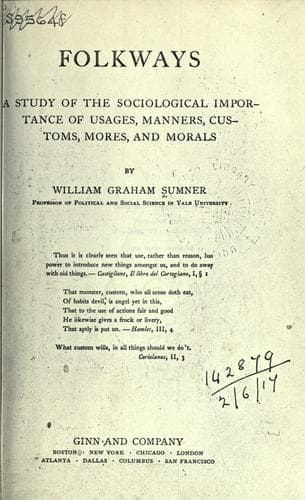
Folkways: A Study of the Sociological Importance of Usages, Manners, Customs, Mores, and MoralsSumner, William Graham
General
Folkways: A Study of the Sociological Importance of Usages, Manners, Customs, Mores, and Morals
Sumner, William Graham
Manners and customs
this horizon from which to take their bearings, and they think that they
have won some authority for their systems when they travel back again
from the generalization to the specific custom out of which it was
deduced. The cases of the inquisitors and witch persecutors who toiled
arduously and continually for their chosen ends, for little or no
reward, show us the relation between mores on the one side and
philosophy, ethics, and religion on the other. (See Chapters IX, XIV,
and XV.)
+233. Orthodoxy in the mores.+ +Treatment of dissent.+ +Selection by
torture.+ It has been observed above (sec. 100) that the masses always
enforce conformity to the mores. Primitive taboos are absolute. There is
no right of private judgment. Renegades, apostates, deserters, rebels,
traitors, and heretics are but varieties of dissenters who are all
subject to disapproval, hatred, banishment, and death. In higher stages
of civilization this popular temper becomes a societal force which
combines with civil arrangements, religious observances, literature,
education, and philosophy. Toleration is no sentiment of the masses for
anything which they care about. What they believe they believe, and they
want it accepted and respected. Illustrations are furnished by zeal for
political parties and for accepted political philosophy. The first
punishment for dissent less than death is extrusion from the society.
Next come bodily pains and penalties, that is, torture. Torture is also
applied in connection with the death penalty, or modes of death are
devised which are as painful as they can be made. The motive is to deter
any one from the class of acts which is especially abominated. In the
cases above cited (sec. 211), under criminal law, it will be observed
that death by burning was applied in the case of incest, or other very
abominable crime, in the laws of Hammurabi and other ancient codes (sec.
234). Such extreme penalties are first devised to satisfy public temper.
The ruler is sure of popularity if he shows rigor and ferocity. His act
will be regarded as just. It is now the popular temper, when any one
commits a crime which is regarded as very horrible, to think and say
what frightful punishment he deserves. It is a primary outpouring of
savage vengeance. When precedents have been established for frightful
punishments, the rulers apply the same in cases of disobedience against
themselves or their authority. Now torture and ferocious penalties have
reached another stage. They were invented by the masses, or in order to
appeal to the masses. They have now become the means of authority and
discipline. The history of torture is a long development of knowledge of
pain, and of devices to cause it. Then it becomes a means which is at
the disposal of those who have the power. The Dominican Izarn, in a
chant of triumph over the Albigenses, represents himself as arguing with
one of them to whom he says, "Believe as we do or thou shalt be
Public-domain text, read in full here on John Shaqi.
Reviews
Reviews
No reviews yet
Be the first to share your thoughts on this work.
Elsewhere in the archive
Join the Discussion
Join the discussion
Sign in to leave a comment or review.
Sign InorCreate an account