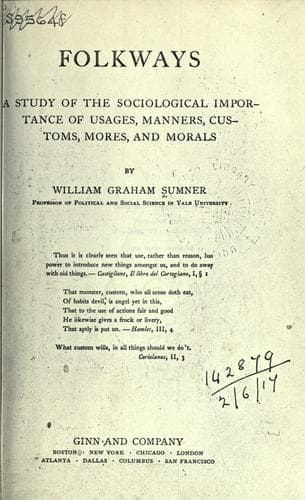
Folkways: A Study of the Sociological Importance of Usages, Manners, Customs, Mores, and MoralsSumner, William Graham
General
Folkways: A Study of the Sociological Importance of Usages, Manners, Customs, Mores, and Morals
Sumner, William Graham
Manners and customs
burned."[506] This is the voice of a victorious party. It is the
enforcement of uniformity against dissent. Systematic and legal torture
then becomes an engine of uniformity and it acts selectively as it
crushes out originality and independent suggestion. It is at the
disposal of any party in power. Like every other system of policy it
loses its effect on the imagination by familiarity, and that effect can
be regained only by intensifying it. Therefore where torture has been
long applied we find that it is developed to grades of incredible
horror.
+234. Execution by burning.+ In the ancient world execution by burning
was applied only when some religious abomination was included in the
crime, or when it seemed politically outrageous. In the laws of
Hammurabi an hierodule who opened a dramshop or entered one to get a
drink was to be burned.[507] One who committed incest with his mother
was to meet the same punishment,[508] also one who married a mother and
her daughter at the same time.[509] In Levit. xx. 14 if a man marries a
mother and her daughter together, all are to be burned, and in Levit.
xxi. 9 the daughter of a priest, if she becomes a harlot, is to be
burned. At the end of the seventh century b.c. some priestly families
connected with the temple of Amon at Napata, Egypt, by way of reform,
introduced the custom of eating the meat of sacrifices uncooked. They
were burned for heresy.[510] In the year 5 B.C., upon a rumor of the
death of Herod I, some Jews tore down the Roman eagle from the gate of
the temple. Herod caused forty-two of them to be burned.[511] Caligula
caused an atellan composer to be burned in the arena for a sarcasm on
the emperor.[512] Constantine ordered that if a free woman had
intercourse with a slave man, the man should be burned.[513] In all the
ancient and classical period, burning was reserved as a most painful
form of death for the most abominable criminals and the most extravagant
and rare crimes. By another law of Constantine it was ordered that if
Jews and heaven worshipers should stone those who were converted from
their sects to the Catholic faith, they should be burned.[514] In the
Theodosian Code, also, any slave who accused his master of any crime
except high treason was to be burned alive without investigation.[515]
Thus burning became the penalty for criminals of a despised class or
race.
+235. Burning in North American colonies.+ In the colonial laws of
Massachusetts, New Jersey, New York, South Carolina, and Virginia it was
provided that negroes should be executed by burning. Here we have a
recrudescence of the idea that great penalties are deterrent. Modern
penologists do not believe that that is true. It is, however, the belief
of the masses, which they have recently shown in methods of lynching. It
might have been believed ten years ago that it would be impossible to
get a crowd of Americans to burn a man at the stake, but there have
been many cases of it.[516]
Public-domain text, read in full here on John Shaqi.
Reviews
Reviews
No reviews yet
Be the first to share your thoughts on this work.
Elsewhere in the archive
Join the Discussion
Join the discussion
Sign in to leave a comment or review.
Sign InorCreate an account