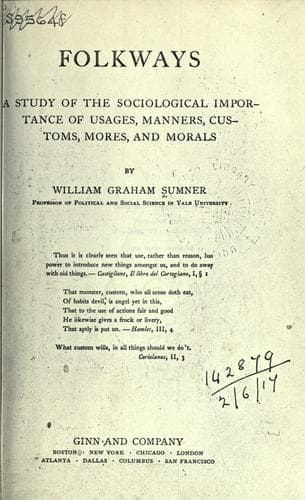
Folkways: A Study of the Sociological Importance of Usages, Manners, Customs, Mores, and MoralsSumner, William Graham
General
Folkways: A Study of the Sociological Importance of Usages, Manners, Customs, Mores, and Morals
Sumner, William Graham
Manners and customs
This means, of course, that by long and manifold suggestion certain
selected forms of crime had been stigmatized until the masses regarded
them with horror. Then the apparatus of the administration of justice
was brought to bear to exterminate all who could be charged with them,
and when the process was objected to as horrible, it was defended on
grounds of necessity to meet the horrible crime. By this action and
reaction a great body of interests was enveloped in a special
atmosphere, within which any excess of savagery was possible. The
societal selection was prosecuted by murder of all dissenters.
+243. Inquisitorial procedure from Roman law.+ The Roman criminal
procedure was, in part, inquisitorial.[553] In the later period of the
republic a private accuser, who must be an injured party, started and
conducted the prosecution, but the magistrates could proceed on their
own motion, upon denunciation, or by inquisitorial process. The last
method became the custom under the empire. Prosecutions for treason were
thus carried on, and by the end of the empire sorcerers and heretics, as
_hostes publici_, like traitors, were thus tried. All citizens were
bound to denounce such criminals. This procedure was taken up into the
canon law, so that the Christian church inherited a system of procedure
as well as the doctrines above stated.[554]
+244. Bishops as inquisitors.+ In the Carolingian period bishops were
instructed to seek out heretics and to secure their conversion, but they
rarely distinguished themselves by zeal in this matter. The procedure
was that of a grand jury set in motion by common report. Lucius III and
Barbarossa, acting together in 1184, prepared a decretal in which the
duty of bishops was reaffirmed and an attempt was made to give sharper
method to their proceedings. They were to seek out heretics, holders of
secret conventicles, or any who "in any way differed, in mode of life,
from the faithful in general." Those who refused to be disciplined and
to conform were to be abandoned to the secular arm for fitting
punishment. All civil officers were to swear to enforce laws against
heretics. Here we find the fundamental notions of the later Inquisition,
but zealous executioners were wanting. If the decretal had been "obeyed
strictly and energetically, it would have established an episcopal
instead of a papal Inquisition."
Public-domain text, read in full here on John Shaqi.
Reviews
Reviews
No reviews yet
Be the first to share your thoughts on this work.
Elsewhere in the archive
Join the Discussion
Join the discussion
Sign in to leave a comment or review.
Sign InorCreate an account