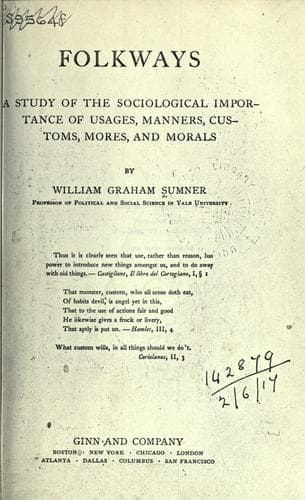
Folkways: A Study of the Sociological Importance of Usages, Manners, Customs, Mores, and MoralsSumner, William Graham
General
Folkways: A Study of the Sociological Importance of Usages, Manners, Customs, Mores, and Morals
Sumner, William Graham
Manners and customs
+241. The ordeal.+ The doctrines and sentiments of this early age were
seed planted to produce an immeasurable crop in the eleventh and twelfth
centuries, when they were brought forth again and quoted with the
authority of the church fathers. The ordeal is a question addressed to
the superior powers in order to learn the truth. The question is always
categorical: Is this man guilty or not? The irrationality is that there
is a third possibility which cannot be tested; the superior powers may
not answer at all. In the early Middle Ages the ordeal was in common use
in all civil and ecclesiastical trials. Experience proved the fallacy of
it. We are led to believe that the people of the dark ages, not yet
being locked in dogmatism, although stupid and ignorant, were better
able to learn from experience than those of later times. Innocent III,
in 1212, forbade the use of the ordeal, the occasion being its use by
the Bishop of Strasburg against heretics.[543] The Lateran Council of
1215 forbade ecclesiastics to take any part in ordeals. It is perhaps
true that torture was introduced from the Roman law after the ordeal was
ruled out.[544]
+242. Irrationality of torture.+ Torture was far more irrational than
the ordeal. The Roman authorities had recorded warnings of its
fallacy.[545] Torture destroys nerve power, will, and consciousness.
There comes a point at which the victim will assent to anything to
escape pain, or to get a quick and easy death. Therefore "confessions"
under torture are of no value. Ulpian said of it, "_Res est fragilis et
periculosa et quae veritatem fallat_."[546] One of the templars said
that if he was tortured further he would confess that he had murdered
the Saviour. Another said that he would confess anything if he was
tortured further, although he was ready to suffer any death for the
Order of Templars. He would confess that he had killed the mother of
God.[547] A heretic under torture cried out that Christ, if so treated,
would be proved a heretic.[548] Bernard Delicieux declared before King
Philip that Peter and Paul could be convicted of heresy by the methods
of the inquisitors.[549] Count Frederick von Spee, a Jesuit who opposed
the witch persecutions, is quoted as saying, in 1631, "Treat the heads
of the church, the judges, or me, as you treat those unhappy ones
[accused of witchcraft], subject any of us to the same tortures, and you
will discover that we are all sorcerers."[550] He quoted an inquisitor
who boasted that if he could get the pope on the rack he would prove him
a sorcerer.[551] In the thirteenth century "judges were well convinced
of the failure of the procedure with its secret and subjective elements,
but they could not in any other way cope with crime."[552]
Public-domain text, read in full here on John Shaqi.
Reviews
Reviews
No reviews yet
Be the first to share your thoughts on this work.
Elsewhere in the archive
Join the Discussion
Join the discussion
Sign in to leave a comment or review.
Sign InorCreate an account