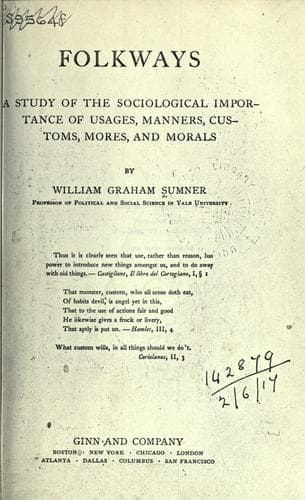
Folkways: A Study of the Sociological Importance of Usages, Manners, Customs, Mores, and MoralsSumner, William Graham
General
Folkways: A Study of the Sociological Importance of Usages, Manners, Customs, Mores, and Morals
Sumner, William Graham
Manners and customs
+247. Persecution popular.+ Innocent III began war on the Albigenses at
the beginning of the thirteenth century, as rebels and heretics. All
Catholics approved what he did, and thought that the Albigenses richly
deserved all the treatment they received. The age was not religious, but
it had intense religiosity, and the whole religiosity was heated to a
high pitch by the contest with the Albigenses. The pride, ambition, and
arrogance of the hierarchy and the basest greed and love of plunder of
the masses were enlisted against them. Lea's statement is therefore
fully justified that "the Inquisition was not an organization
arbitrarily devised and imposed upon the judicial system of Christendom
by the ambition or fanaticism of the church. It was rather a
natural--one may almost say an inevitable--evolution of the forces at
work in the thirteenth century, and no one can rightly appreciate the
process of its development and the results of its activity without a
somewhat minute consideration of the factors controlling the minds and
souls of men during the ages which laid the foundation of modern
civilization."[564] In the mind of the age "there was a universal
consensus of opinion that there was nothing to do with a heretic but to
burn him." This was one of those wide and popular notions upon which
mores grow, because the folkways are adjusted to it in all departments
of life as a rule of welfare. The courts of Toulouse at first, not
recognizing the forces against the Albigenses, tried to protect their
subjects, but "to the public law of the period [Raymond II of Toulouse]
was an outlaw, without even the right of self-defense against the
first-comer, for his very self-defense was rated among his crimes. In
the popular faith of the age he was an accursed thing, without hope,
here or hereafter. The only way of readmission into human fellowship,
the only hope of salvation, lay in reconciliation with the church
through the removal of the awful ban which had formed half of his
inheritance. To obtain this he had repeatedly offered to sacrifice his
honor and his subjects, and the offer had been contemptuously
spurned.... The battle of toleration against persecution had been fought
and lost; nor, with such a warning as the fate of the two Raymonds, was
there risk that other potentates would disregard the public opinion of
Christendom by ill-advised mercy to the heretic."[565]
Public-domain text, read in full here on John Shaqi.
Reviews
Reviews
No reviews yet
Be the first to share your thoughts on this work.
Elsewhere in the archive
Join the Discussion
Join the discussion
Sign in to leave a comment or review.
Sign InorCreate an account