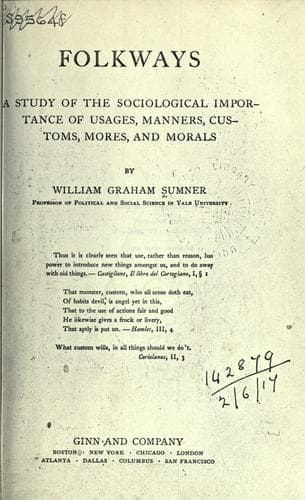
Folkways: A Study of the Sociological Importance of Usages, Manners, Customs, Mores, and MoralsSumner, William Graham
General
Folkways: A Study of the Sociological Importance of Usages, Manners, Customs, Mores, and Morals
Sumner, William Graham
Manners and customs
+248.+ An annalist of Worms is quoted about Dorso's operations on the
upper Rhine in 1231. Dorso burned many persons of the peasant class. The
annalist adds, "The people, when they saw this, were favorable to the
inquisitors and helped them; and rightly, since those heretics deserved
death. Confident in the approval of the masses, they went on to make
arrests in towns and villages, as they pleased, and then they said to
the judges, without further evidence, 'These are heretics. We withdraw
our hands from them.' The judges were thus compelled to burn many. That
was not according to the sense of the Holy Scriptures, and the
ecclesiastics everywhere were greatly troubled. Since, however, the
people took sides with the unjust judges, their will was executed
everywhere." "The pitiless and incompetent judges later saw that they
could not maintain their conduct without the help of great men, whom
they won by saying that they would burn rich people, whose goods the
great men should have." "That pleased the great men, who helped them,
and called them to their cities and towns." "The people, when they saw
this, asked the reason, to which the persecutors answered, 'We would
burn a hundred innocent if there was one guilty amongst them.'"[566]
+249.+ It was also true of the persecutions of the philosophers in
Mohammedan Spain that they were popular. "The best educated princes
allowed themselves to be driven to persecute, in spite of their personal
preferences, as a means of winning popularity."[567]
+250. Theory of persecution.+ The public opinion of the ruling classes
of Europe demanded that heresy should be exterminated at whatever cost,
and yet with the suppression of open resistance the desired end seemed
as far off as ever.... Trained experts were needed, whose sole business
it should be to unearth the offenders and extort a confession of their
guilt.... Thus to the public of the thirteenth century the organization
of the Inquisition and its commitment to the children of Saint Dominic
and Saint Francis appeared a perfectly natural or rather inevitable
development arising from the admitted necessities of the time and the
instrumentalities at hand.[568]
Public-domain text, read in full here on John Shaqi.
Reviews
Reviews
No reviews yet
Be the first to share your thoughts on this work.
Elsewhere in the archive
Join the Discussion
Join the discussion
Sign in to leave a comment or review.
Sign InorCreate an account