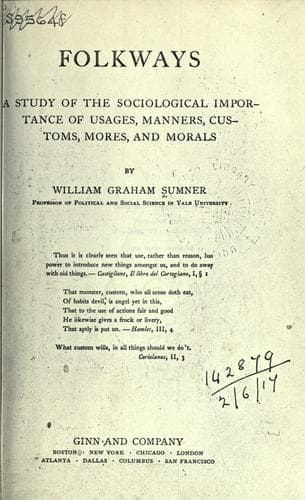
Folkways: A Study of the Sociological Importance of Usages, Manners, Customs, Mores, and MoralsSumner, William Graham
General
Folkways: A Study of the Sociological Importance of Usages, Manners, Customs, Mores, and Morals
Sumner, William Graham
Manners and customs
+256. Formative legislation.+ In 1252 Innocent IV issued a bull "which
should establish machinery for systematic persecution as an integral
part of the social edifice in every city and every state." He authorized
the torture of witnesses. "These provisions are not the wild imaginings
of a nightmare, but sober, matter-of-fact legislation, shrewdly and
carefully devised to accomplish a settled policy, and it affords us a
valuable insight into the public opinion of the day to find that there
was no effective resistance to its acceptance." There is evidence,
twenty years later, that the Inquisition "had not been universally
accepted with alacrity, but the few instances which we find recorded of
refusal show how generally it was submitted to." The institution was in
full vigor in Italy, but not beyond the Alps, "yet this was scarce
necessary so long as public law and the conservative spirit of the
ruling class everywhere rendered it the highest duty of the citizen of
every degree to aid in every way the business of the inquisitor, and
pious monarchs hastened to enforce the obligations of their subjects."
"It was not the fault of the church if a bold monarch like Philip the
Fair occasionally ventured to incur divine vengeance by protecting his
subjects."[579]
+257. Dungeons.+ It is evident that the lust of blood was educated into
the mores by public executions with torture, by obscene adjuncts, by
inhuman sports, and by public shows. Cruelty and inhumanity in civil
cases were as great as under the Inquisition. A person apprehended on
any charge was imprisoned in a frightful dungeon, damp, infested by rats
and vermin, generally in chains, and he was often forced to lie in a
constrained position. This was a part of the policy which prevailed in
the administration of justice. It was intended to break the spirit and
courage of the accused. Confinement was solitary, and various
circumstances besides pain and hunger were brought to bear on the
imagination. It was the rule that every accused person must fast for
eight or ten hours before torture. The dungeons were often ingenious
means of torture. There was one in the Bastille at Paris, the floor of
which was conical, with the point downwards so that it was impossible to
sit, or lie, or stand in it. In another, in the Chatelet, the floor was
all the time covered by water, in which the prisoners must stand.[580]
Public-domain text, read in full here on John Shaqi.
Reviews
Reviews
No reviews yet
Be the first to share your thoughts on this work.
Elsewhere in the archive
Join the Discussion
Join the discussion
Sign in to leave a comment or review.
Sign InorCreate an account