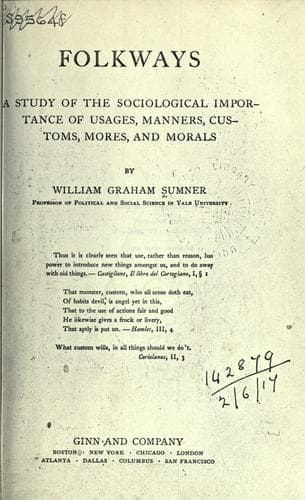
Folkways: A Study of the Sociological Importance of Usages, Manners, Customs, Mores, and MoralsSumner, William Graham
General
Folkways: A Study of the Sociological Importance of Usages, Manners, Customs, Mores, and Morals
Sumner, William Graham
Manners and customs
+255. The Inquisition took shape slowly.+ The Inquisition took shape
very gradually through the first half of the thirteenth century. "In the
proceedings of this period the rudimentary character of the Inquisition
is evident." The mendicant orders furnished the first agents. They were
admired and honored by the masses. Gregory IX, in his first bulls
(1233), making the Dominicans the official inquisitors, seemed to be
uncertain as to the probable attitude which the bishops would adopt to
this invasion of their jurisdiction, "while the character of his
instructions shows that he had no conception of what the innovation was
to lead to." "As yet there was no idea of superseding the episcopal
functions." In fact, the mendicant orders supplanted the military orders
as papal militia, just as they were later supplanted by the Jesuits, and
they very greatly assisted the reorganization of the church into an
absolute monarchy under the pope.[576] Frederick II died in 1250. He was
the first modern man on a throne. He had aimed to rule all Christendom
by despotic methods which he perhaps learned from the Mohammedans. He
would have made a monarchy if he had succeeded, which would have
anticipated that of Charles V or Philip II by three hundred years.[577]
It was the mores of the age which decided between him and the pope. His
court was a center of Arabic culture and of religious indifference.
There were eunuchs, a harem, astrologers from Bagdad, and Jews richly
pensioned by the emperor to translate Arabic works. "All these things
were transmuted, in popular belief, into relations with Ashtaroth and
Beelzebub."[578] The saying that there had been three great
impostors--Moses, Jesus, and Mohammed--was attributed to him, and it
appears that his contemporaries generally believed that he first used
the statement. The only thing which he left behind was the code of laws
which he had made, by way of concession and attempt to buy peace from
the popes, by which all civil authorities were made constables and
hangmen of the church, to which all dissenters were sacrificed.
Public-domain text, read in full here on John Shaqi.
Reviews
Reviews
No reviews yet
Be the first to share your thoughts on this work.
Elsewhere in the archive
Join the Discussion
Join the discussion
Sign in to leave a comment or review.
Sign InorCreate an account