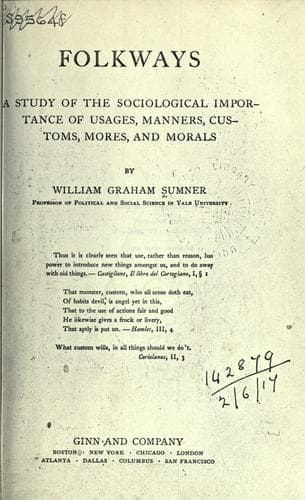
Folkways: A Study of the Sociological Importance of Usages, Manners, Customs, Mores, and MoralsSumner, William Graham
General
Folkways: A Study of the Sociological Importance of Usages, Manners, Customs, Mores, and Morals
Sumner, William Graham
Manners and customs
+259. Confiscation.+ Another penalty of frightful effect was
confiscation. As soon as a man was arrested for heresy, his property was
sequestrated and inventoried. His family was thrown on the street. It
was out of the Roman law that "pope and king drew the weapons which
rendered the pursuit of heresy attractive and profitable." "The church
cannot escape the responsibility of naturalizing this penalty in
European law as a punishment for spiritual transgressions."[585] "It
would be difficult to estimate the amount of human misery arising from
this source alone." "The threats of coercion which at first were
necessary to induce the temporal princes to confiscate the property of
their heretical subjects soon became superfluous, and history has few
displays of man's eagerness to profit by his fellow's misfortunes more
deplorable than that of the vultures which followed in the wake of the
Inquisition to batten on the ruin which it wrought." In Italy the
confiscated property was divided into three parts by the pope's order.
One part went to the Inquisition for its expenses, one part to the papal
camera, and one part to the civil authority. Later, the civil authority
generally got nothing. About 1335 a Franciscan bishop of Silva
"reproached those of his brethren who act as inquisitors with their
abuse of the funds accruing to the Holy Office.... The inquisitors
monopolized the whole, spent it on themselves, or enriched their kindred
at their pleasure." "Avarice joined hands with fanaticism, and between
them they supplied motive power for a hundred years of fierce,
unremitting, unrelenting persecution which, in the end, accomplished its
main purpose." The confiscations did not concern the populace. They
furnished the motive of the great to support the administration of the
Inquisition.[586] "Persecution, as a steady and continuous policy,
rested, after all, upon confiscation. It was this which supplied the
fuel to keep up the fires of zeal, and when it was lacking the business
of defending the faith languished lamentably. When katharism disappeared
under the brilliant aggressiveness of Bernard Gui, the culminating point
of the Inquisition was passed, and thenceforth it steadily declined,
although still there were occasional confiscated estates over which
king, prelate, and noble quarreled for some years to come."[587] "The
earnest endeavors of the inquisitors were directed much more to
obtaining conversions with confiscations and betrayal of friends than to
provoking martyrdoms.... The really effective weapons of the Holy
Office, the real curses with which it afflicted the people, can be
looked for in its dungeons and its confiscations, in the humiliating
penances of the saffron crosses, and in the invisible police with which
it benumbed the heart and soul of every man who had once fallen into its
hands."[588] It is evident that these means of tormenting and coercing
dissenters went much further to cause them to disappear than autos-de-fe
Public-domain text, read in full here on John Shaqi.
Reviews
Reviews
No reviews yet
Be the first to share your thoughts on this work.
Elsewhere in the archive
Join the Discussion
Join the discussion
Sign in to leave a comment or review.
Sign InorCreate an account