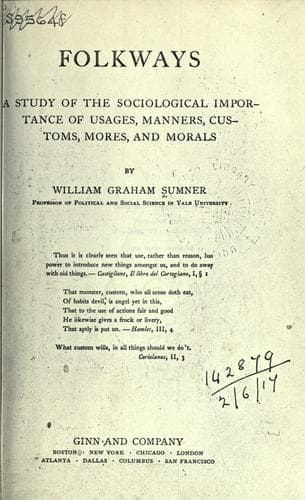
Folkways: A Study of the Sociological Importance of Usages, Manners, Customs, Mores, and MoralsSumner, William Graham
General
Folkways: A Study of the Sociological Importance of Usages, Manners, Customs, Mores, and Morals
Sumner, William Graham
Manners and customs
and other executions. The selection of those who submitted, or played
the hypocrite, was accomplished in the fifteenth century.
+260. Operation of the Inquisition.+ The Inquisition acted effectively.
It kept detailed records and pursued its victims to the third
generation.[589] It covered Europe with a network of reports which would
rival the most developed modern police systems, "putting the authorities
on the alert to search for every stranger who wore the air of one
differing in life and conversation from the ordinary run of the
faithful." "To human apprehension, the papal Inquisition was well-nigh
ubiquitous, omniscient, and omnipotent." Inquisitors were set free from
all rules which had been found necessary to save judges from judicial
error,[590] and the formularies to guide inquisitors inculcated chicane,
terrorism, deception, and brow-beating, and an art of entangling the
accused in casuistry and dialectics. A new crime was invented for the
cases in which confession could not be obtained: suspicion of heresy,
which had three degrees, "light," "vehement," and "violent." Even papal
decretals which restrained the effort to destroy the accused could be
set aside.[591] Thus the Inquisition cooperated with the criminal law.
It operated on the society of Christendom for ten or twelve generations
a selection of those who would submit and obey, and an elimination of
those who dissented.
+261. Success of the Inquisition.+ That the Inquisition succeeded in its
purpose is certain. It forced at least external conformity and silence,
especially of the masses. The heterodoxy of the Middle Ages "is
divisible into two currents, of which one, called the 'eternal gospel,'
includes the mystical and communistic sects which, starting from Joachim
de Florus, after having filled the twelfth and thirteenth centuries ...
was carried on, in the fourteenth, by the German mystics; the other,
summed up in the blasphemy that there had been three great impostors
[Moses, Jesus, and Mohammed], represents materialistic infidelity, due
to a study of the Arabs, and skulking under the name of Averroes."[592]
Of these two schools of heretics the former was the more popular and
tenacious. It is not to be understood that the masses ever recognized
their own handiwork in the Inquisition, or the popes of the fifteenth
century. On the contrary, the sequence goes on to the fourth stage in
which the masses, seeing the operation of ambition, venality, and
despotism in the officers of the institution created to meet a popular
demand, denounce it and turn against it to destroy it.
Public-domain text, read in full here on John Shaqi.
Reviews
Reviews
No reviews yet
Be the first to share your thoughts on this work.
Elsewhere in the archive
Join the Discussion
Join the discussion
Sign in to leave a comment or review.
Sign InorCreate an account