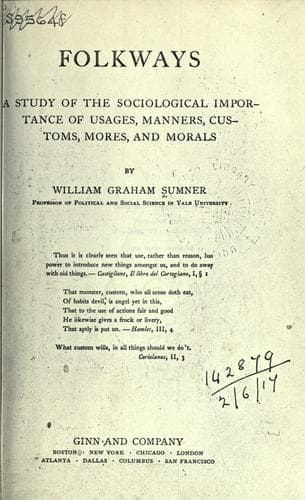
Folkways: A Study of the Sociological Importance of Usages, Manners, Customs, Mores, and MoralsSumner, William Graham
General
Folkways: A Study of the Sociological Importance of Usages, Manners, Customs, Mores, and Morals
Sumner, William Graham
Manners and customs
It follows that the repressive system of the mediaeval church did
not produce effects on the mores in England.
+266. The Spanish Inquisition.+ The Spanish Inquisition is an
offshoot and development of that of the mediaeval church. The
latter was started in Aragon and Navarre in 1238.[609] In the
latter half of the fourteenth century Eymerich (author of the
_Directorium Inquisitorum_) conducted an inquisition in Aragon
against Jews and Moors. In Castile, in 1400, an inquisition was
in activity.[610] None of these efforts produced a permanent
establishment. In the reign of Isabella, Cardinal Mendoza
organized the Inquisition as a state institution to establish the
throne.[611] The king named the inquisitors, who need not be
ecclesiastics. The confiscated property of "heretics" fell to the
state. Ecclesiastics were subject to the tribunal. The church
long withheld approval from this inquisition, because it was
political in origin and purpose, and was created outside the
church organization and without church authorization. The
populace also opposed it. This union of church and populace
forced the grandees to support it.[612] The punishments "implied
confiscation of property. Thus whole families were orphaned and
consigned to penury. Penitence in public carried with it social
infamy, loss of civil rights and honors, intolerable conditions
of ecclesiastical surveillance, and heavy pecuniary fines.
Penitents who had been reconciled returned to society in a far
more degraded condition than convicts released on ticket of
leave. The stigma attached in perpetuity to the posterity of the
condemned, whose names were conspicuously emblazoned upon church
walls as foemen to Christ and to the state."[613] When "the
Spanish viceroys tried to introduce the Spanish Inquisition at
Naples and Milan, the rebellious people received protection and
support from the papacy, and the Holy Office, as remodeled in
Rome, became a far less awful engine of oppression than that of
Seville."[614] The Spanish Inquisition went on to a new form,
free from papal and royal control and possessing a "specific
organization."[615] "Like the ancient councils of the time of the
Goths, the Inquisition is an arm which serves, in the hands of
the monarch, to finish the subjugation of the numerous
semi-feudal nobles created by the conquest, because before the
faith there are no privileged persons, and no one is sheltered
from the ire of the terrible tribunal. Its intervention is so
absolute, and its dedication to its function so extravagant,
that, rendering itself more Catholic than the pope, it usurps his
authority and revolts against the orders of the pontiff, giving
to the peninsular church the character of a national church, with
the king at the head as pontiff, and the inquisitor by his side
Public-domain text, read in full here on John Shaqi.
Reviews
Reviews
No reviews yet
Be the first to share your thoughts on this work.
Elsewhere in the archive
Join the Discussion
Join the discussion
Sign in to leave a comment or review.
Sign InorCreate an account