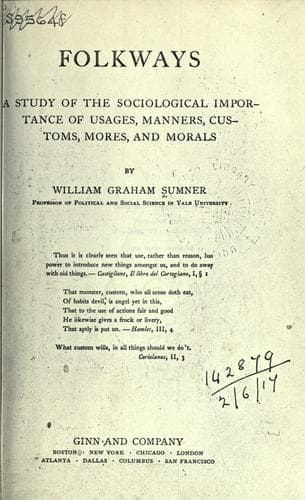
Folkways: A Study of the Sociological Importance of Usages, Manners, Customs, Mores, and MoralsSumner, William Graham
General
Folkways: A Study of the Sociological Importance of Usages, Manners, Customs, Mores, and Morals
Sumner, William Graham
Manners and customs
by ritual devices is morally subject to the deepest corruption of
character. The church system had corrupted the mores by adding casuistry
and dialectic smartness to the devices for regulating conduct and
satisfying interests. The men of the Renaissance, especially in Italy,
acted always from passionate motives and went to great excess. Their
only system of conduct was success in what they wanted to do, and so
they were often heroes of crime. Yet they all conformed to church ritual
and discipline.
+264.+ A great undertaking like the suppression of dissent by force and
cruelty cannot be carried out in a great group of states without local
differentiation and variation. To close the story, it is worth while to
notice these variations in England, Spain, and Venice.
+265. Torture in England.+ The Inquisition cannot be said to have
existed in the British Islands or Scandinavia. The laws of
Frederick II had no authority there. In England, in 1400, the
death penalty for heresy was introduced by the statute _de
heretico comburendo_. In 1414 a mixed tribunal of ecclesiastics
and laymen was established to search out heretics and punish
them. It was employed to suppress Lollardry. Under Edward VI
these laws were repealed; under Mary they were renewed. In the
first Parliament of Elizabeth they were repealed again, except
the statute of 1400, which was repealed in 1676, when Charles II
wanted toleration for Roman Catholics. Then the ecclesiastical
courts were restricted to ecclesiastical penalties.[603] Torture
was never legal in England. The use of it was pushed to the
greatest extreme when Clement V and Philip the Fair were seeking
evidence against the templars. Then the pope wrote a fatherly
letter of expostulation to Edward of England, because of the lack
of this engine in his dominions.[604] Cases of torture no doubt
occurred. The star chamber had an inquisitorial process in which
the rack seems to have been used. Barbaro, a Venetian ambassador
in the sixteenth century, reported the non-use of torture as an
interesting fact in English mores. He says the English think that
it often forces untrue confession, that it "spoils the body and
an innocent life; thinking, moreover, that it is better to
release a criminal than to punish an innocent man."[605] From the
thirteenth century it was forbidden to keep a prisoner in chains.
In other countries this was the rule, and ingenuity was expended
to fasten the prisoner in a most uncomfortable position.[606] The
last case of the rack in the star chamber was that of Peacham, in
1614.[607] The last execution for heresy in the British Islands
was that of a medical student at Edinburgh, eighteen years of
age, named Aikenhead, in 1696.[608] The greatest cruelty in
England was "pressing" prisoners to compel them to plead because,
if they did not plead, the trial could not go on.
Public-domain text, read in full here on John Shaqi.
Reviews
Reviews
No reviews yet
Be the first to share your thoughts on this work.
Elsewhere in the archive
Join the Discussion
Join the discussion
Sign in to leave a comment or review.
Sign InorCreate an account