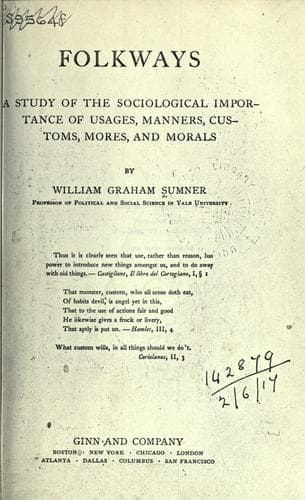
Folkways: A Study of the Sociological Importance of Usages, Manners, Customs, Mores, and MoralsSumner, William Graham
General
Folkways: A Study of the Sociological Importance of Usages, Manners, Customs, Mores, and Morals
Sumner, William Graham
Manners and customs
+268. Use of the Inquisition for political and personal
purposes.+ In spite of the religiosity of the age there were
princes and factions which cared more for political power than
for theological questions. When the power of the Inquisition was
established many ecclesiastical and civil persons desired to
employ its agency for their personal or party ends. Boniface
VIII, in the bull _Unam Sanctam_, laid down in full force the
doctrine of papal supremacy and independence. Any one who
resisted the power lodged by God in the church resisted God,
unless, like the Manichaeans, he believed in two principles, in
which case he was a heretic. If the pope errs, he can be judged
by God alone. There is no earthly appeal. "We say, declare,
define, and pronounce, that it is necessary to salvation that
every human creature be subjected to the Roman pontiff." "It was
soon perceived that an accusation of heresy was a peculiarly easy
and efficient method of attacking a political enemy."[622] John
XXII, in his quarrel with Visconti, trumped up charges of heresy
which won public opinion away from Visconti, disassociated his
friends, and ruined him. Heresy and damnation were used to and
fro, as interest dictated, and only for policy.[623] This is the
extreme development of the action against dissenters in its third
stage, the abuse of power for selfish purposes. "Heretic" became
an epithet of immense power in factional quarrels, and the
Inquisition was a weapon which any one could use who could seize
it. Hence effects on the mores were produced in an age when
factions were numerous and their quarrels constant. In these
cases, however, the selectional effect was only against the
personal enemies of the powerful, and was not a societal effect
at all.
Public-domain text, read in full here on John Shaqi.
Reviews
Reviews
No reviews yet
Be the first to share your thoughts on this work.
Elsewhere in the archive
Join the Discussion
Join the discussion
Sign in to leave a comment or review.
Sign InorCreate an account