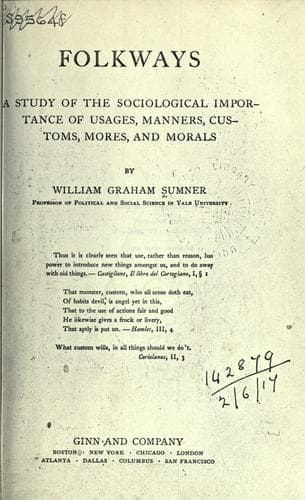
Folkways: A Study of the Sociological Importance of Usages, Manners, Customs, Mores, and MoralsSumner, William Graham
General
Folkways: A Study of the Sociological Importance of Usages, Manners, Customs, Mores, and Morals
Sumner, William Graham
Manners and customs
+269.+ We have distinguished four stages in the story of the attempt to
establish religious uniformity under papal control in the Middle Ages.
I. The church taught doctrines and alleged facts about the wickedness of
aberrant opinions. II. The masses, accepting these teachings, built
deductions upon them, and drew inferences as to the proper treatment of
dissenters. They put the inferences in effect by lynching acts. III. The
leaders of society accepted the leadership of these popular movements,
and the church went on to teach hatred of dissenters and extreme abuse
of them. It elevated persecution to a theory of social welfare by the
extermination of dissenters, reduced the views and notions of the masses
to dogmas, and led in selection by murder. IV. These ideas and practices
were then vulgarized by the masses again. Trial by torture, bloody
executions, and finally witchcraft persecutions were the results in the
next stage. Witchcraft persecutions were not selective. They are well
worth study as the greatest illustration of the degree of aberration
which the mores may undergo, but they lie aside from the present topic.
In savage life alleged witchcraft is punished with great torture and a
painful death,[624] but nothing of the kind is found in any of the
great religions except Latin Christianity.
[373] Burckhardt, _Kulturgesch. Griechenlands_, I, 211.
[374] JAI, XI, 44.
[375] Ratzel, _Voelkerkunde_, II, 163.
[376] _Britisch Guiana_, II, 428.
[377] Grupp, _Kulturgesch. der Roem. Kaiserzeit_, I, 32.
[378] Scherr, _Kulturgesch._, 109.
[379] Rudeck, _Oeffentl. Sittlichkeit_, 45.
[380] _Deutsches Leben_, 285, 297, 332.
[381] Lippert, _Kulturgesch._, I, 370.
[382] _Bur. Ethnol._, V, 488.
[383] Cary and Tuck, _Chin Hills_, I, 173.
[384] JAI, XVI, 87; cf. Fritsch, _Eingeb. Sued-Afr._, 170.
[385] _Bijdragen tot T.L. en V.-kunde_, XXXV, 67.
[386] JAI, XIII, 280.
[387] _Austral. Assoc. Adv. Sci._, 1892, 622.
[388] Hagen, _Unter den Papuas_, 241.
[389] _Ibid._, 213.
[390] Woodford, _Naturalist among Headhunters_, 178.
[391] Paulitschke, _Ethnog. N.O. Afrikas_, I, 93.
[392] _Anthropology_, 243.
[393] JAI, XVII, 235.
[394] Buettner, _Das Hinterland van Walfischbai_, 235.
[395] _South Africa_, I, 298.
[396] Schweinfurth, _Heart of Afr._, I, 153.
[397] JASB, III, 370.
[398] Finsch, _Samoafahrten_, 90.
[399] Schwaner, _Borneo_, I, 221.
[400] Ratzel, _Voelkerkunde_, II, 570.
[401] Pommerol, _Une Femme chez les Sahariennes_, 243.
[402] _Smithson. Rep._, 1895, 594.
[403] _Umschau_, IV, 789.
[404] Yriarte, _La Vie d'un Patricien de Venise_, 58.
[405] _Ibid._, 53.
[406] Du Camp, _Paris_, VI, 388.
[407] Galton, _Human Faculty_, 6, 8.
[408] _Century Magazine_, XLII, 89.
[409] _Deutsche Frauenwelt_, II, 65.
[410] Patrick in _Psych. Rev._, VIII, 113.
[411] _Orat._, XXXVI.
[412] Beloch, _Griech. Gesch._, II, 29.
Public-domain text, read in full here on John Shaqi.
Reviews
Reviews
No reviews yet
Be the first to share your thoughts on this work.
Elsewhere in the archive
Join the Discussion
Join the discussion
Sign in to leave a comment or review.
Sign InorCreate an account