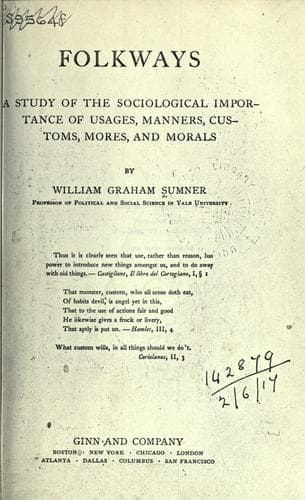
Folkways: A Study of the Sociological Importance of Usages, Manners, Customs, Mores, and MoralsSumner, William Graham
General
Folkways: A Study of the Sociological Importance of Usages, Manners, Customs, Mores, and Morals
Sumner, William Graham
Manners and customs
+270. Origin and motives.+ Slavery is a thing in the mores which
is not well covered by our definition. Slavery does not arise in
the folkways from the unconscious experimentation of individuals
who have the same need which they desire to satisfy, and who try
in separate acts to do it as well as they can. It is rather due
to ill feeling towards members of an out-group, to desire to get
something for nothing, to the love of dominion which belongs to
vanity, and to hatred of labor. "The simple wish to use the
bodily powers of another person, as a means of ministering to
one's own ease or pleasure, is doubtless the foundation of
slavery, and as old as human nature."[625] "There is an
extraordinary power of tyranny invested in the chiefs of tribes
and nations of men that so vastly outweighs the analogous power
possessed by the leaders of animal herds as to rank as a special
attribute of human society, eminently conducive to
slavishness."[626] The desire to get ease or other good by the
labor of another, and the incidental gratification to vanity,
seem to be the fundamental principles in slavery, when
philosophically regarded, after the rule of one man over others
has become established. The whole group, however, must approve of
the custom and must enforce it; otherwise it cannot exist. It
appears that slavery began historically with the war captive, if
he or she was not put to death, as he was liable to be by the
laws of war. Those laws put the defeated, with his wife,
children, and property, at the mercy of the victors. The defeated
might be tortured to death, as was done amongst the North
American Indians, or they might be saved from death by the women.
Then they were put to help the women and were rated as women.
Slavery, therefore, in its origin, was a humanitarian improvement
in the laws of war, and an alleviation of the status of women. It
seems to be established that it began where the economic system
was such that there was a gain in making a slave of a war captive
instead of killing him. It follows that slavery, wherever it has
existed, has affected all the mores of the society. It promised
great results gratis. It will appear below that it has been a
terrible afrit, a demon which promised service but which became a
master. When adopted into the folkways it has dominated and given
tone and color to them all. That is the reason for giving it a
place here.
Public-domain text, read in full here on John Shaqi.
Reviews
Reviews
No reviews yet
Be the first to share your thoughts on this work.
Elsewhere in the archive
Join the Discussion
Join the discussion
Sign in to leave a comment or review.
Sign InorCreate an account