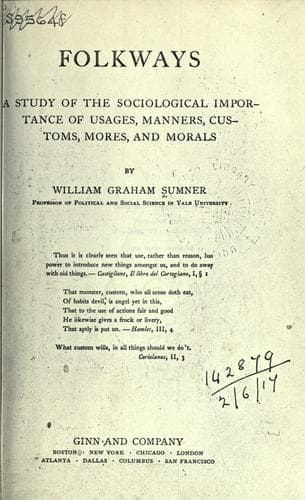
Folkways: A Study of the Sociological Importance of Usages, Manners, Customs, Mores, and MoralsSumner, William Graham
General
Folkways: A Study of the Sociological Importance of Usages, Manners, Customs, Mores, and Morals
Sumner, William Graham
Manners and customs
+271. Slavery taught steady labor.+ It seems to be also right to
understand that slavery proved to be a great schoolmaster to
teach men steady work. If that view is correct, we must
understand that no men would do any hard, persistent work if they
could help it. The defeated were forced to it, and learned to
submit to it. Then they helped the whole society up to a higher
status, in which they also shared.[627] Von Goetzen gives some
proof of this when he states that he and his troop of carriers
sat by the camp fire evenings and that one after another told his
life. "Nearly all had been, as children, brought from the inner
country to the coast by slave dealers. Now they were proud of
this slavery, proud of belonging to the 'cultivated' and of not
being any longer 'wild' men."[628] In that view slavery is a part
of the discipline by which the human race has learned how to
carry on the industrial organization. There are some tasks which
have been very hard and very disagreeable. Comrades in an
in-group have never forced these on each other. It seemed to be
good fun, as well as wise policy, to make members of a rival
out-group do these tasks, after defeating them in war. For women
the grinding of seeds (grain) always was a heavy burden until
modern machinery brought natural powers to do it. For men the
rowing of boats (galleys) has been a very hard kind of work.[629]
After slavery came to exist it was extended to other cases, even
to some classes of cases in the in-group. Of these cases the
first was that of debt. Amongst the Eveans a debtor who cannot
pay is put to death. This, however, is a very exceptional
rule.[630] The course of thought is, that a debtor has used
another man's product and is bound to replace it. He therefore
falls into servitude to his creditor in fact, whether it is so
expressed or not. He must live on and work for the creditor.
Another case in which slavery was introduced was that of crime.
The criminal fell under obligations of restitution of value to an
individual or to the whole (chief). Other cases of extension of
slavery will appear below. We have many cases of groups exploited
by other groups. The former are then inferior and despised groups
who are tyrannized over by others who have beaten them in war or
easily could do so.
Public-domain text, read in full here on John Shaqi.
Reviews
Reviews
No reviews yet
Be the first to share your thoughts on this work.
Elsewhere in the archive
Join the Discussion
Join the discussion
Sign in to leave a comment or review.
Sign InorCreate an account