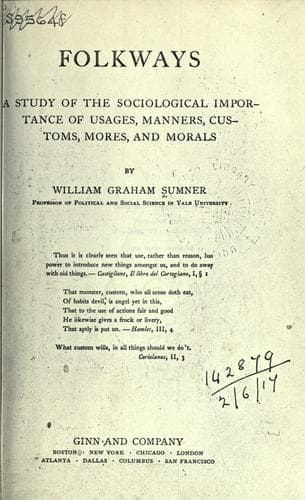
Folkways: A Study of the Sociological Importance of Usages, Manners, Customs, Mores, and MoralsSumner, William Graham
General
Folkways: A Study of the Sociological Importance of Usages, Manners, Customs, Mores, and Morals
Sumner, William Graham
Manners and customs
+272. Servitude of group to group.+ Agriculture is a peaceful
occupation, the pursuit of which breeds out the physical strength
of nomadism. The cases in which nomads rule over tillers belong,
in general, under this head, more especially because such a
difference in the economy of life produces mutual contempt and
hatred. The Israelites entered Canaan as nomads, and their
relation to the Canaanites was that which is here described.
Another case is presented by the smiths, who generally appear as
the earliest handicraftsmen, but are regarded with doubt and
suspicion. They are not slaves, but they are treated as outcasts.
Very often, in case of conquest by an invading tribe, the smiths
remain under the invaders as a subject and despised caste. The
Masarva are descendants of Betchuanas and Bushmen. They stand in
a relation of slaves to the Betchuanas, Matabele, and Marutse, in
whose land they dwell, except that they may not be sold.[631] The
Vaganda are subject to the Vahuma.[632] The latter keep out of
sight, being inferior in civilization but greater in power. Von
Goetzen also met with the Vahuma as rulers over the Vahuta, i.e.
"belongers," as they called them.[633] The Arabs hold the negroes
of Borku in subjection and rob them of the date harvest.[634] In
other parts of the same district a nomad section rules over a
settled section of the same population.[635] Nomads hold
themselves to be the proper ones to rule.[636] The Hyksos's
invasion of Egypt is a case of the subjection of tillers by
nomads, attended by all the contempt of men on one grade of
civilized effort for those on another.[637] The combination of
the two, the nomads forming the ruling caste of military nobles,
forms a strong state.[638] The Tuaregs of the Sahara do not allow
the inhabitants of Kauar to raise vegetables or grains, but force
them to buy the same of them (the Tuaregs), which they bring to
them from the Sudan to buy salt, which the Kauar dwellers must
have ready.[639] The Akarnanians, in 1350, sold themselves to the
barbarians, in a body, in order to escape want.[640] The Masai
are another group of warriors and raiders. The Varombutta do
their hunting and tilling for them.[641] The Makololo hold the
Makalaka in similar serfdom, but the subjection is easy and the
servitude light, because the subject individuals can easily run
away.[642] The Hupa of California hold their neighbors in similar
subjection and in tributary servitude.[643] Other cases are
furnished by the Vanyambo, west of the Victoria Nyassa,[644] and
the Djur, who long served the Nubians as smiths.[645] It gives us
pleasure to learn that, about sixty years ago, the inferior
tribes on Uvea (Tai), of the Loyalty group, revolted against the
dominant tribe and nearly exterminated it.[646]
Public-domain text, read in full here on John Shaqi.
Reviews
Reviews
No reviews yet
Be the first to share your thoughts on this work.
Elsewhere in the archive
Join the Discussion
Join the discussion
Sign in to leave a comment or review.
Sign InorCreate an account