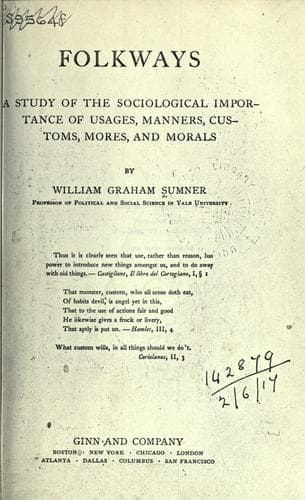
Folkways: A Study of the Sociological Importance of Usages, Manners, Customs, Mores, and MoralsSumner, William Graham
General
Folkways: A Study of the Sociological Importance of Usages, Manners, Customs, Mores, and Morals
Sumner, William Graham
Manners and customs
Alaska.[680] In 1841 it was reckoned that one third of the entire
population from northern British Columbia to southern Alaska were
"slaves of the most helpless and abject description." "The great
supply was obtained by trade with the southern Indians, in which
the Tsimshian acted as middlemen. They were kidnapped or captured
by the southern Indians from their own adjacent tribes and sold
to the Tsimshian, who traded them to the northern Thlinkit and
interior Tinne tribes for furs." "Slaves did all the drudgery,
fished for their owner, strengthened his force in war, were not
allowed to hold property or to marry, and when old and worthless
were killed. The master's power was unlimited." The slave must
commit any crime at the command of the master. The slaves were
set free at some ceremonies, but they were put to death at the
funerals of chiefs, or as foundation sacrifices, or in reparation
for insults or wrongs. The northern Indians were more warlike and
would not make good slaves. The Oregon flatheads were docile and
industrious.[681] The Chinooks became the wealthiest tribe in the
region by acting as middlemen to sell war captives taken inland
as far from home as possible.[682] Amongst the Thlinkits slaves
are forbidden to wear the labret, and sex intercourse with a
slave woman disgraces a free man.[683] "Amongst the early Central
Americans the slave who achieved any feat of valor in war
received his liberty and was adopted by the Capulli, or
clan."[684] In Mexico there were slaves of three
classes,--criminals, war captives, and persons who had
voluntarily sold themselves or had been sold by their parents.
The captor generally sacrificed a prisoner, but might hold him as
a slave. Those who sold themselves did so to get a fund for
gambling. There was a public slave mart at Azcapuzalco. The
system is described as kind, but slaves might lose their lives
through the act of the master at feasts or funerals.[685] "Actual
slavery of the Indians in Mexico continued as late as the middle
of the seventeenth century."[686] It is evident that slavery
existed all over North and Central America, but was more
developed on the Pacific coast than in the Mississippi valley.
The meat eaters of the buffalo region had less opportunity to use
the institution.[687]
Public-domain text, read in full here on John Shaqi.
Reviews
Reviews
No reviews yet
Be the first to share your thoughts on this work.
Elsewhere in the archive
Join the Discussion
Join the discussion
Sign in to leave a comment or review.
Sign InorCreate an account