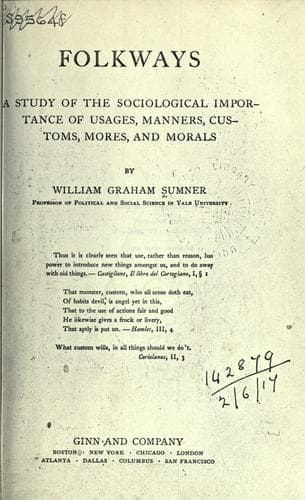
Folkways: A Study of the Sociological Importance of Usages, Manners, Customs, Mores, and MoralsSumner, William Graham
General
Folkways: A Study of the Sociological Importance of Usages, Manners, Customs, Mores, and Morals
Sumner, William Graham
Manners and customs
+278. Slavery in South America.+ In South America we also meet
with at least one case of a tribe, or part of a tribe, which is
in clientage to another tribe. This is a subdivision of the third
rank of the Mbaya, who voluntarily entered into a relation of
clientage to the Mbaya, giving them service under arms, and in
house and field, without being their slaves, being protected in
return by the powerful and feared tribe.[688] The Guykurus carry
on frequent wars to get captives, whom they keep in stringent
servitude. "There is, perhaps, no tribe of South American
Indians, among whom the state of slavery is so distinctly marked
as among them." Slaves and free do not intermarry, lest marriage
be profaned. There is no way in which a slave may become
free.[689] The Guykurus are the strongest tribe in the valley of
the Paraguay. They have horses and were called by the Portuguese
Cavalleiros.[690] In Brazil it was thought that the cultivation
of the country was impossible unless the Indians were made
slaves. The early laws and orders of the kings of Portugal seem
to reveal a sincere desire to control greed and cruelty. In 1570
private slave raids were forbidden and slavery was confined to
those captured in public and just war. Lisbon, however, became a
great slave mart by the law that slaves passing from one colony
(Africa) to another (America) must pass through Lisbon and pay a
tax there. Peter Martyr is quoted that slavery was necessary for
Indians who, if they had no master, would go on with their old
customs and idolatry. Slavery killed them, however. It did not
make them laborers.[691] In general, in the valley of the Yapura,
in the first half of the nineteenth century, slaves were war
captives who were very unkindly treated.[692] The aborigines
began to sell their war captives to Europeans soon after the
latter arrived. They wanted rosewood especially, and they took
Indians to Africa as slaves.[693] Boggiani[694] expresses the
opinion in regard to the savages of the Chaco, as the meadow
region on the Paraguay river is called, that slavery amongst a
people of more civilized mores, is, for them, "an incalculable
benefit," and that "to hinder slavery, in such circumstances,
would be a capital error." "It is necessary to force them to come
out of their brutelike condition, and to awaken their
intelligence, which is not wanting, if they receive practical and
energetic direction." Bridges[695] says that one Fuegian is
thrown into clientage to another by their mode of life. "For a
young man, with no wife and few relatives, must live with some
one who can protect him, and with whom he can live in comfort,
whose wife or wives can catch fish for him, etc."
Public-domain text, read in full here on John Shaqi.
Reviews
Reviews
No reviews yet
Be the first to share your thoughts on this work.
Elsewhere in the archive
Join the Discussion
Join the discussion
Sign in to leave a comment or review.
Sign InorCreate an account