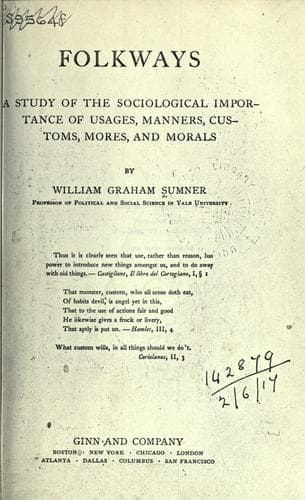
Folkways: A Study of the Sociological Importance of Usages, Manners, Customs, Mores, and MoralsSumner, William Graham
General
Folkways: A Study of the Sociological Importance of Usages, Manners, Customs, Mores, and Morals
Sumner, William Graham
Manners and customs
were overhasty and tried to lower themselves by bamboos and
rattans. The god, angry at this, condemned them to slavery. The
myth, therefore, accounts for a caste of slaves. Formerly also
war captives and criminals who could not pay fines became slaves.
Debts cause men to fall into pawnship. Extravagant living, and
gambling, lead to this condition. If a man becomes pawn for a
debt his whole household goes with him. All have to work very
hard to try to satisfy a greedy master. The pawn is entitled to
one tenth of the harvest, or of the gain by trade. Free men
despise pawns.[719] Wilken[720] says of the Bataks that a slave,
by diligence and thrift, can always buy himself. In addition to
all the ill chances of gambling, extravagance, making love to
another man's wife, etc., by which a man may become a debtor
slave, customs exist which are traps for the unwary. Sago and
rice are left in the woods, in some islands, until wanted. If a
man passes the store, he is supposed to take away the spirit of
the goods. If caught, he and all his family become slaves. If a
man dies who was wont to fish at a certain place, the place
becomes taboo to his ghost. Any one who fishes there becomes a
slave to his family. Also, if a district is in mourning, any one
who breaks the mourning customs is made a slave.[721] The
education of the Chinese in ethical doctrines has made slavery
amongst them slight and mild. It is attributed to poverty, which
forces parents to sell their daughters.[722] The owners must
provide female slaves with husbands, and the law forbids the
separation of husband and wife, or of parents and little
children.[723] It appears that slavery is forbidden by law, but
is tolerated in the case where the parents are poor. Boys once
enslaved continue in bondage and their children follow them, but
there is no legal possession. Girls become free at marriage.[724]
+281. Slavery in Asia.+ Slavery in Asia is of a kind which puts the
slave largely at the mercy of his owner, but the mores have taught the
slave owner to use his power with consideration. This is generally, not
universally, true. Nivedita says[725] that "slavery in Asia, under the
regime of great religious systems, has never meant what Europe and
America have made of it.... It is a curious consequence of this humanity
of custom [or rather, of the judgment in the mores as to the wisest
course of conduct in a class of cases] that the word 'slave' cannot be
made to sting the Asiatic consciousness as it does the European."
Public-domain text, read in full here on John Shaqi.
Reviews
Reviews
No reviews yet
Be the first to share your thoughts on this work.
Elsewhere in the archive
Join the Discussion
Join the discussion
Sign in to leave a comment or review.
Sign InorCreate an account