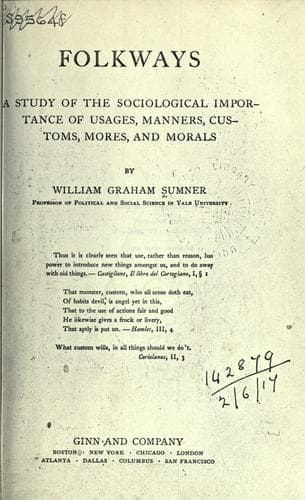
Folkways: A Study of the Sociological Importance of Usages, Manners, Customs, Mores, and MoralsSumner, William Graham
General
Folkways: A Study of the Sociological Importance of Usages, Manners, Customs, Mores, and Morals
Sumner, William Graham
Manners and customs
At Koetei, on the Mahakkam in Borneo, all well-to-do people have
debtors in pawn, whose position is somewhat better than that of
slaves. The debtors seem content and submissive. Captives taken
on head-hunting expeditions are held as slaves until human
sacrifices are wanted.[708] The souls of all those who are put to
death at the death of a Dyak rajah become his servants in the
other world. In this world the killer can command, as his fetich,
the soul of the killed. On the death of a great man his debtor
slaves are bound to the carved village post, which indicates the
glory of head-hunting, and are tortured to death.[709] "Slavery
is greatly practiced" on Timorlaut. A thief, debtor, slanderer,
or defamer may become the slave of the one he has wronged. The
slave trade is also active between the islands.[710] The slaves
of the sea Dyaks adopt their customs and become contented.
Sometimes they win affection and are adopted, freed, and married
to free women. Slaves and masters eat together the same food in
the rural villages.[711] Among the land Dyaks slaves, by
destitution and debt, "are just as happy as if perfectly free,
enjoying all the liberty of their masters, who never think of
ill-using them."[712] In old times one who set a house on fire
was liable to become the slave of any one who was burned
out.[713] Slaves on Timor do not seem to care for liberty. Their
livelihood would not be so certain. There is a kind of slavery to
the kingdom, not to any individual, but the slave cannot be sold
by the king.[714] In the Barito valley a debtor slave has to do
any kind of work. He may be punished by blows, or fines added to
his debt, which may also be increased by any breaches of customs,
or by the value of broken tools or vessels. A month after a child
is born to him ten gulden are added, also expenses of education
when the child is ready to go to work. He may be slain at a feast
of the dead by his master. The owner can torment the debtor by
new fines, and keep up the debt or even increase it.[715] In the
Katingan valley there are no debtor slaves, because after three
years a debtor who cannot pay becomes an hereditary slave, and
cannot get his liberty even if he should get the means to pay his
debt.[716] If he ever gets the means to pay and attempts to free
himself he is compelled to pay fees, taxes, and customary dues to
the "spirits of the house," etc. When he leaves his master's
house he must not return to it for a year or two, nor eat
anything brought from it--"to prove his independence." Then he
gives a feast and becomes free.[717] "Slavery and pawnship are,
in the nature of the case, the same."[718] The Dyaks put their
Eden on a cloud island. They have a myth that the daughters of
the great Being let down seven times seven hundred cords of gold
thread in order to lower mortals upon a mountain, but the mortals
Public-domain text, read in full here on John Shaqi.
Reviews
Reviews
No reviews yet
Be the first to share your thoughts on this work.
Elsewhere in the archive
Join the Discussion
Join the discussion
Sign in to leave a comment or review.
Sign InorCreate an account