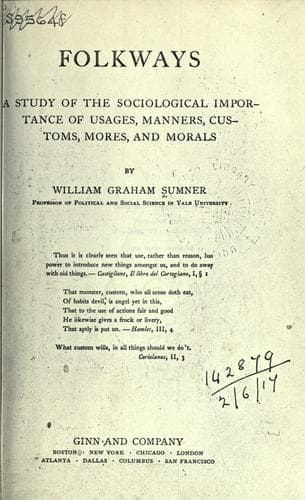
Folkways: A Study of the Sociological Importance of Usages, Manners, Customs, Mores, and MoralsSumner, William Graham
General
Folkways: A Study of the Sociological Importance of Usages, Manners, Customs, Mores, and Morals
Sumner, William Graham
Manners and customs
+285. Slavery in the classical states.+ Slavery came to the two great
classical states from the antecedent facts of savage and barbaric life.
When Aristotle came to study slavery he could not find a time when it
was not. We have seen how it had become one of the leading institutions
of uncivilized society, and how it had been developed in different forms
and degrees. The two great classical states, more especially Rome, built
their power on slavery. Both states pursued their interests with little
care for the pain they might inflict on others, or the cost in the
happiness of others. The Roman state began by subjugating its nearest
neighbors. It used its war captives as slaves, increased its power,
conquered more, and repeated the process until it used up all the known
world. The Phoenicians were merchants, who kidnapped men, women, and
children, if they found opportunity, and sold them into slavery far from
home. The Ionians, who grew rich by commerce, bought slaves and
organized states in which slaves did all the productive work. In both
Greece and Rome productive work came to be despised. One is amazed to
find how easily any one who went on a journey might fall into slavery,
or how recklessly the democracy of one city voted to sell the people of
a defeated city into slavery, yet how unhesitatingly everybody accepted
and repeated the current opinions about the baseness of slave character.
Homer says that a slave has only half the soul of a man.[738] The love
stories in the _Scriptores Erotici_ very often contain an incident of
kidnapping. The story of Eumaeus must have been that of many a
slave.[739] It is also only rarely and very incidentally that the
classical writers show any pity for slaves, although they often speak of
the sadness of slavery.[740] If any man, especially a merchant, who went
on a journey incurred a great risk of slavery, why was not slavery a
familiar danger of every man, and therefore a matter for pity and
sympathy? In the great tragedies the woes of slavery, especially the
contrasts for princes and princesses, heroes and heroines, are often
presented. Polyxena, in Euripides's _Hekuba_, 360, bewails her
anticipated lot as a slave. A fierce master will buy her. She will have
to knead bread for him, to sweep and weave, leading a miserable life,
given as wife to some base slave. She prefers to be sacrificed at
Achilles's tomb. When the Greeks were going to kill her, she asked them
to keep their hands off. She would submit. Let her die free. "It would
be a shame to me, royal, to be called a slave amongst the dead." In the
_Trojan Women_ the screams of the Trojan women are heard, as they are
distributed by lot to their new Greek masters. The play is full of the
woes of slavery. At Athens slaves enjoyed great freedom of manners and
conduct. They dressed like the poorest freedmen. No one dare misuse the
slave of another simply because he was a slave. If the master abused a
Public-domain text, read in full here on John Shaqi.
Reviews
Reviews
No reviews yet
Be the first to share your thoughts on this work.
Elsewhere in the archive
Join the Discussion
Join the discussion
Sign in to leave a comment or review.
Sign InorCreate an account