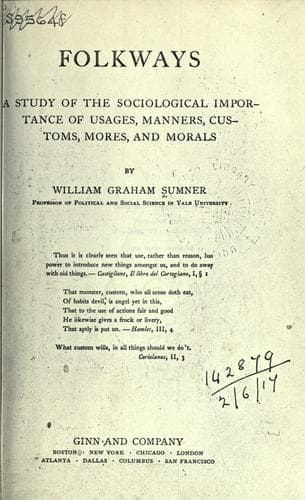
Folkways: A Study of the Sociological Importance of Usages, Manners, Customs, Mores, and MoralsSumner, William Graham
General
Folkways: A Study of the Sociological Importance of Usages, Manners, Customs, Mores, and Morals
Sumner, William Graham
Manners and customs
slave, the latter had an asylum in the temple and could demand to be
sold. Slaves could pursue any trade which they knew, paying a stipulated
sum to their owners, and could thus buy their manumission. Their
happiness, however, depended on the will of another.[741] In the law
they were owned as things were, and could be given, lent, sold, and
bequeathed. They could not possess property, nor have wives in assured
exclusive possession against masters. Their children belonged to their
masters. Plato thought that nature had made some to command, others to
serve.[742] He thought the soul of a slave base, incapable of good,
unworthy of confidence.[743] Aristotle thought that every well-appointed
house needs animate and inanimate tools. The animate tools are slaves,
who have souls, but not like those of their masters. They lack will.
Slaves are like members of the master, ruled by his will. Their virtue
is obedience.[744] He says that there were men in his time who said that
slavery was an injustice due to violence and established by law.[745]
+286. Slavery at Rome.+ It is in ancient Rome that we find slavery most
thoroughly developed. Any civilization which accomplishes any great
results must do so by virtue of force which it has at its disposal. The
Romans conquered and enslaved their nearest neighbors. By virtue of
their increased power they extended their conquests. They repeated this
process until they had consumed all the known world. The city of Rome
was a center towards which all the wealth of the world was drawn. There
was no reverse current of goods. What went out from Rome was
government,--peace, order, and security. The provinces probably for a
time made a good bargain, although the price was high. In the earliest
times slaves were used for housework, but were few in number per
household. In 150 B.C. a patrician left to his son only ten. Crassus had
more than five hundred. C. Caec. Claudius, in the time of Augustus, had
4116.[746] In the early days a father and his sons cultivated a holding
together. Slaves were used when more help was needed. There was one
slave to three sons and they lived in constant association of work and
play. When conquest rendered slaves numerous and cheap, free laborers
disappeared.[747] Ti. Semp. Gracchus, in 177 B.C., after the war in
Sardinia, sold so many Sardinian slaves that "cheap as a Sardinian"
became a proverb.[748] His son Tiberius is reported to have been led
into his agrarian enterprise by noticing that the lands of Etruria were
populated only by a few slaves of foreign birth.[749] Buecher[750] puts
together the following statistics of persons reduced to slavery about
200 B.C.: after the capture of Tarentum (209 B.C.), 30,000; in 207 B.C.,
5400; in 200 B.C., 15,000.[751] Roman slaves were not allowed to marry
until a late date. They were systematically worked as hard as it was
possible to make them work, and were sold or exposed to perish when too
old to work.
Public-domain text, read in full here on John Shaqi.
Reviews
Reviews
No reviews yet
Be the first to share your thoughts on this work.
Elsewhere in the archive
Join the Discussion
Join the discussion
Sign in to leave a comment or review.
Sign InorCreate an account