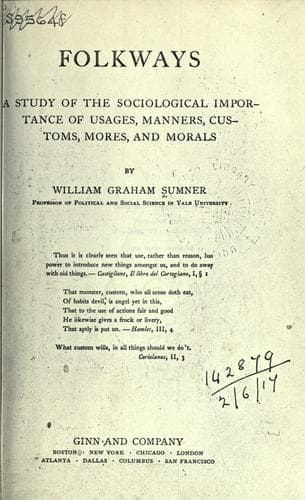
Folkways: A Study of the Sociological Importance of Usages, Manners, Customs, Mores, and MoralsSumner, William Graham
General
Folkways: A Study of the Sociological Importance of Usages, Manners, Customs, Mores, and Morals
Sumner, William Graham
Manners and customs
Such was the policy taught by the older Cato.[752] The
number on the market was always great; the price was low; it was more
advantageous to work them so hard that they had no time or strength to
plot revolts. This is the most cynical refusal to regard slaves as human
beings which can be found in history. They were liable to be tortured in
their owners' cases in court. They might be given over to the
gladiatorial shows and set to fight each other, or wild beasts.
Seventy-eight gladiators condemned to fight to the death revolted in 74
B.C. under Spartacus, who defeated five armies. Crassus was sent
against him with eight legions. Lucullus was recalled from Thrace and
Pompey from Spain. Spartacus was cut to pieces in his last battle.
Crassus crucified six thousand prisoners along the road from Capua to
Rome.[753]
+287. Slave revolts.+ The severity of the Roman system of slavery
is shown by the number of revolts and the severe proceedings in
each of them. There was such a revolt in 499 B.C. The guilty were
crucified. The following year there was another.[754] In 416
there was another. The aim always was to take the citadel and
burn the city.[755] Sicily was covered with a swarm of slaves at
the beginning of the second century B.C. They were especially
Syrians, very tough and patient. They were managed under Cato's
plan: "Work or sleep!" In 196 B.C. the slaves in Etruria revolted
and were suppressed with great severity.[756] In 104 those of
Sicily revolted. They were subdued four years later and the last
remnant were sent to Rome to fight beasts. They killed themselves
in the arena.[757] The later Roman system was that the mob of the
city put the world in the hands of one or another, and he gave
them bread and games as their part of the plunder. The
_frumentaria_ were the permanent and steady pay of the "world
conquerors." They made herding the best use of Italian land.
"Where before industrious peasants prospered in glad contentment,
now unfree herdsmen, in wide wastes, drove the immense herds of
Roman senators and knights."[758] The Sicilian landowners left
their shepherds to steal what they needed, so that they were
educated to brigandage. The greatest sufferer was the small
freeman.[759] There is a story in Diodorus,[760] of Damophilos,
an owner of great _latifundia_, whose slaves came to him to beg
clothes. He replied: "Do the travelers, then, go naked through
the country? Are they not bound to pay toll to him who needs
clothes?" He caused them to be flogged and sent them back to
work. The misery of the slave population seems to have reached
its acme at Enna where two roads across the island cross each
other. The town lies 3000 feet high. It was a great fortress down
into the Middle Ages.[761] At this place began a slave revolt,
led by a Syrian skilled in sorcery. The slaves took the city and
engaged in rapine and murder.
Public-domain text, read in full here on John Shaqi.
Reviews
Reviews
No reviews yet
Be the first to share your thoughts on this work.
Elsewhere in the archive
Join the Discussion
Join the discussion
Sign in to leave a comment or review.
Sign InorCreate an account