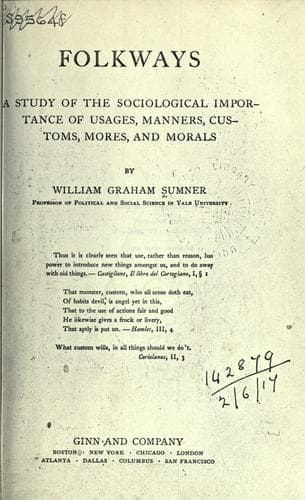
Folkways: A Study of the Sociological Importance of Usages, Manners, Customs, Mores, and MoralsSumner, William Graham
General
Folkways: A Study of the Sociological Importance of Usages, Manners, Customs, Mores, and Morals
Sumner, William Graham
Manners and customs
+289. Manumission. Natural liberty.+ The slave dealers developed tricks
far surpassing those of horse dealers in modern times.[770] By
enfranchisement the owner got rid of the worst worry of slavery, and
tied the freedman to himself by a contract which it was for the interest
of the freedman to fulfill. The owner made a crafty gain.[771]
Tacitus[772] says that, in his time, the Roman people was almost
entirely freedmen. If that is so, we must notice that the "people,"
under the empire, are a different set from what they were under the
republic. When the Romans got an educated artisan as a slave they set
him to teach a number of others. When no more outsiders were conquered
and enslaved the slaves taught each other. The work then became gross
and ran down.[773] This was another of the ways in which Rome consumed
the products and culture of the world. Very few instances, real or
fictitious, of sympathy with slaves can be cited. In the story of
_Trimalchio_, Encolpius and his friends beg off a slave who is to be
whipped for losing the garment of another slave in the bath. At a supper
at which Augustus was present a slave broke a vase. His master ordered
him cast to the _murenae_ in a tank. The slave begged Augustus to obtain
for him an easier death, which Augustus tried to do. The master refused.
Augustus then gave the slave complete grace, broke the host's other
vases himself, and ordered the tank filled up.[774] Under Nero, Pedanius
having been murdered, his slaves, four hundred in number, were all
condemned to death, according to law. The populace rose against this
sentence, which was fulfilled, but it shows that there was a popular
judgment which would respond upon occasion.[775] "Not once, in all
antiquity, does a serious thought about the abolition of slavery
arise."[776] It was the basis of the entire social and political order.
They were in terror of the slaves and despised them, but could not
conceive of a world without them. Probably we could not either, if we
had not machines by means of which we make steam and electricity work
for us. Individuals were manumitted on account of the gain to the
master. The owner said, in the presence of a magistrate, "I will that
this man be free, after the manner of the Quirites." The magistrate
touched the head of the slave with his rod, the master boxed his ears,
and he was a free man.[777] The law provided a writ, "resembling in some
respects the writ of _habeas corpus_, to compel any one who detained an
alleged freedman to present him before a judge."[778] The Roman lawyers
also, if they could find a moment during gestation when the mother had
been free, employed legal fiction to assume that the child had been born
at that moment.[779] Florentinus defined slavery as "a custom of the law
of nations by which one man, contrary to the law of nature, is subjected
to the dominion of another."[780] Ulpian likewise said that, "as far as
natural law is concerned, all men are equal."[781]
Public-domain text, read in full here on John Shaqi.
Reviews
Reviews
No reviews yet
Be the first to share your thoughts on this work.
Elsewhere in the archive
Join the Discussion
Join the discussion
Sign in to leave a comment or review.
Sign InorCreate an account