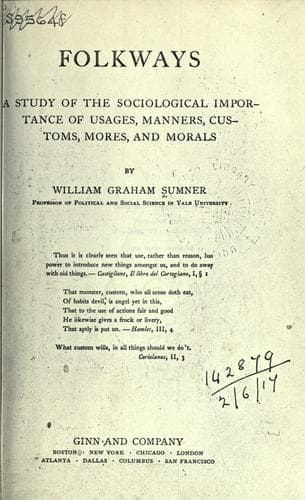
Folkways: A Study of the Sociological Importance of Usages, Manners, Customs, Mores, and MoralsSumner, William Graham
General
Folkways: A Study of the Sociological Importance of Usages, Manners, Customs, Mores, and Morals
Sumner, William Graham
Manners and customs
+290. Slavery as represented in the inscriptions.+ "The inscriptions
reveal to us a better side of slave life, which is not so prominent in
our literary authorities." They show cases of strong conjugal affection
between slave spouses, and of affection between master and slave.[782]
In the first century the waste of the fortunes won by extortion from the
provinces, and the opening of industrial opportunities by commerce, with
security, gave great stimulus to free industry. The inscriptions "show
the enormous and flourishing development of skilled handicrafts," with
minute specialization. "The immense development of the free proletariat,
in the time of the early empire, is one of the most striking social
phenomena which the study of the inscriptions has brought to light." The
time was then past when Roman society depended entirely on slave labor
for the supply of all its wants.[783] Dill thinks that "the new class of
free artisans and traders had often, so far as we can judge by stone
records, a sound and healthy life, sobered and dignified by honest toil,
and the pride of skill and independence."[784] The slave acted only
under two motives, fear and sensuality. Both made him cowardly,
cringing, cunning, and false, and at the same time fond of good eating
and drinking and of sensual indulgence. As he was subject to the orders
of others, he lacked character, and this suited his master all the
better. The morality of slaves extended in the society, and the society
was guided by the views of freedmen in its intellectual activity. The
strongest symptom of this was the prevalence of a morality of tips,
which put on the forms of liberality. It was no more disgrace to take
gifts than to give them. Senators took gifts from the emperor, and all,
including the emperor, reckoned on legacies. Thus the lack of character
spread.[785] Slavery proved a great corrupter of both slaves and owners.
It was the chief cause of the downfall of the state which had been
created by it. It made cowards of both owners and slaves. "The woes of
negro slaves were insignificant, like a drop to an ocean, in comparison
with the sufferings of ancient slaves, for the latter generally belonged
to civilized peoples."[786]
Public-domain text, read in full here on John Shaqi.
Reviews
Reviews
No reviews yet
Be the first to share your thoughts on this work.
Elsewhere in the archive
Join the Discussion
Join the discussion
Sign in to leave a comment or review.
Sign InorCreate an account