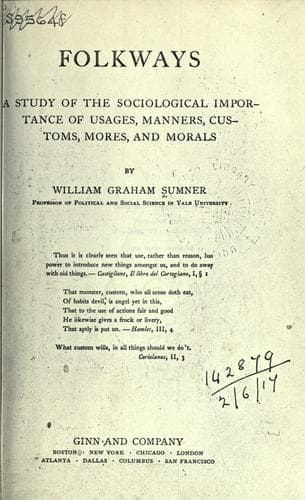
Folkways: A Study of the Sociological Importance of Usages, Manners, Customs, Mores, and MoralsSumner, William Graham
General
Folkways: A Study of the Sociological Importance of Usages, Manners, Customs, Mores, and Morals
Sumner, William Graham
Manners and customs
+298. Depopulation.+ The depopulation of Italy under the empire is amply
proved. Vespasian moved population from Umbria and the Sabine territory
to the plain of Rome.[819] Marcus Aurelius established the Marcomanni in
Italy.[820] Pertinax offered land in Italy and the provinces to any one
who would cultivate it.[821] Aurelian tried to get land occupied.[822]
He sent barbarians to settle in Tuscany.[823] As time went on more and
more land was abandoned and greater efforts were made to secure
settlers. Valentinian settled German prisoners in the valley of the
Po.[824] In the time of Honorius, in Campania five hundred thousand
arpents were discharged from the _fiscus_ as deserted and waste. In the
third century, if the colon ran away from land which no one would take
he was pursued by all the agencies of the law and brought back like a
criminal.[825] The colons ran away because the _curiales_, their
masters, put on them the taxes which the state levied first on the
_curiales_.[826] What was wanted was men. The Roman imperial system had
made men scarce by making life hard. Pliny said that the _latifundia_
destroyed Italy. The saying has been often quoted in modern times as if
it had some unquestionable authority. It is a case of the common error
of confusing cause and consequence. The _latifundia_ were a consequence
and a symptom. Heisterbergk[827] thinks that the _latifundia_ were not
produced by economic causes, but by vanity and ostentation. The owners
did not look to the land for revenue. He asks[828] how a strictly
scientific system of grand culture with plenty of labor could ruin any
country. Rodbertus[829] thinks that the _latifundia_ went from a grand
system to a petty system between the times of the elder and the younger
Pliny by the operation of the law of rent. He thinks that there must
have been garden culture in Italy at the beginning of the empire, and
that the colonate arose from big estates with petty industry and from
the law of mortgage. He thinks, further, that the colons, until the
fourth century, were slaves, and that their status was softened by the
legislation of the fourth century. Heisterbergk thinks that the colonate
began in the corn provinces, and that it was, at the beginning of the
fourth century, on the point of passing away, but the legislation of the
fourth century perpetuated it. He thinks that it was injured, as an
institution, by the great increase of taxation after Diocletian. Then
legislation was necessary to keep the colons on the land.[830]
Public-domain text, read in full here on John Shaqi.
Reviews
Reviews
No reviews yet
Be the first to share your thoughts on this work.
Elsewhere in the archive
Join the Discussion
Join the discussion
Sign in to leave a comment or review.
Sign InorCreate an account