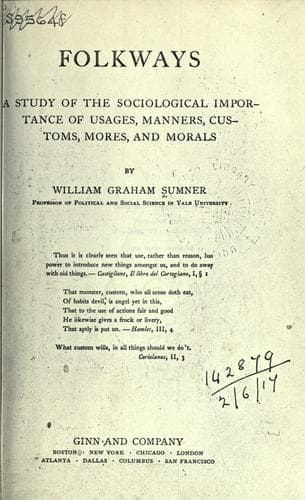
Folkways: A Study of the Sociological Importance of Usages, Manners, Customs, Mores, and MoralsSumner, William Graham
General
Folkways: A Study of the Sociological Importance of Usages, Manners, Customs, Mores, and Morals
Sumner, William Graham
Manners and customs
+297. The colonate.+ At the end of the empire population was declining,
land was going out of use and returning to wilderness, the petty
grandees in towns were crushed by taxes into poverty, artisans were
running away and becoming brigands because the state was immobilizing
them, and peasants were changed into colons. The imperial system went on
until the man, the emperor, was above all laws, the senate were slaves,
and the provinces were the booty of the emperor. The whole system then
became immobilized. What the colons were and how they came into
existence has been much disputed. They were immobilized peasants. We
find them an object of legislation in the _codex Theodosianus_ in the
fourth century. They were personally free (they could marry, own
property, could not be sold), but they were bound to the soil by birth
and passed with it. They cultivated the land of a lord, and paid part of
the crops or money.[813] Marquardt thinks that they arose from
barbarians quartered in the Roman empire.[814] Heisterbergk[815] thinks
that there are three possible sources, between which he does not
decide,--impoverished freemen, emancipated slaves, barbarian prisoners.
Wallon[816] ascribes the colonate to the administration. As society
degenerated it became harder and harder to get the revenue, and the
state adopted administrative measures to get the property of any one who
had any. This system impoverished everybody. To carry it out it was
necessary to immobilize everybody, to force each one to accept the
conditions of his birth as a status from which he could not escape. What
made the colonate, then, was misery.[817] Emancipated slaves and
impoverished peasants met in the class of colons, in state servitude.
The proprietors were only farmers for the state. The tribute was the due
of the state. Laborers were enrolled in the census and held for the
state. The interest of the _fiscus_ held the colon to the soil.[818] The
words "colon" and "slave" are used interchangeably in the _codex
Justinianus_.
Public-domain text, read in full here on John Shaqi.
Reviews
Reviews
No reviews yet
Be the first to share your thoughts on this work.
Elsewhere in the archive
Join the Discussion
Join the discussion
Sign in to leave a comment or review.
Sign InorCreate an account