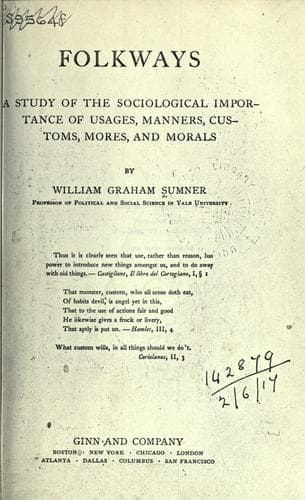
Folkways: A Study of the Sociological Importance of Usages, Manners, Customs, Mores, and MoralsSumner, William Graham
General
Folkways: A Study of the Sociological Importance of Usages, Manners, Customs, Mores, and Morals
Sumner, William Graham
Manners and customs
That might be a
Hercules fit only for a dime museum. Seventy-eight of the combinations
are inharmonious, but have one strong element.[71] In societal matters
it is by no means indifferent whether the equal sums of societal value
are made up of very unequal, or of harmonious, components. So in a group
of a million persons the chance of a great genius, who would stand alone
towards _X_ is just the same as that of an utter idiot who would stand
alone towards _x_, and the reason why the number at the mode is so great
is that the societal value is the sum of components, of which many sums
may be equal, although the components are very unequal. Two strata at
equal distances above and below _O_ are equal in number, so far as their
useful powers and resistances go, but education introduces a new
component which destroys their equality and forces a redistribution.
Galton[72] suggests that, if people who would when adults fall in
classes _V_, _W_, or _X_ in our diagram could be recognized in infancy,
and could be bought for money, it would be a great bargain for a nation,
England for instance, to buy them for much money and rear them as
Englishmen. Farr estimated the baby of an agricultural laborer as worth
L5, capital value. A baby who could be reared to take a place in the
class _X_ would have a capital value of thousands of pounds. The capital
value would be like that of land of different degrees of natural
advantage, but none of it yet exploited.
+52. The masses and the mores.+ In connection with the mores the masses
are of very great importance. The historical or selected classes are
those which, in history, have controlled the activities and policy of
generations. They have been differentiated at one time by one standard,
at another time by another. The position which they held by inheritance
from early society has given them prestige and authority. Merit and
societal value, according to the standards of their time, have entered
into their status only slightly and incidentally. Those classes have had
their own mores. They had the power to regulate their lives to some
extent according to their own choice, a power which modern civilized men
eagerly desire and strive for primarily by the acquisition of wealth.
The historical classes have, therefore, selected purposes, and have
invented ways of fulfilling them. Their ways have been imitated by the
masses. The classes have led the way in luxury, frivolity, and vice, and
also in refinement, culture, and the art of living. They have introduced
variation. The masses are not large classes at the base of a social
pyramid; they are the core of the society. They are conservative. They
accept life as they find it, and live on by tradition and habit. In
other words, the great mass of any society lives a purely instinctive
life just like animals. We must not be misled by the conservatism of
castes and aristocracies, who resist change of customs and institutions
by virtue of which they hold social power.
Public-domain text, read in full here on John Shaqi.
Reviews
Reviews
No reviews yet
Be the first to share your thoughts on this work.
Join the Discussion
Join the discussion
Sign in to leave a comment or review.
Sign InorCreate an account