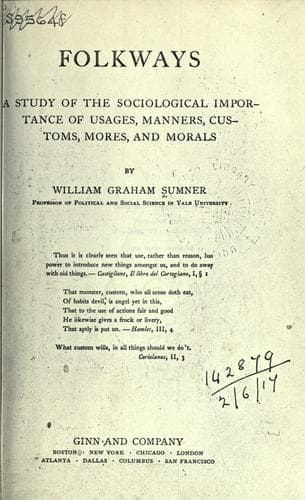
Folkways: A Study of the Sociological Importance of Usages, Manners, Customs, Mores, and MoralsSumner, William Graham
General
Folkways: A Study of the Sociological Importance of Usages, Manners, Customs, Mores, and Morals
Sumner, William Graham
Manners and customs
+63. How laws and institutions differ from mores.+ When folkways have
become institutions or laws they have changed their character and are to
be distinguished from the mores. The element of sentiment and faith
inheres in the mores. Laws and institutions have a rational and
practical character, and are more mechanical and utilitarian. The great
difference is that institutions and laws have a positive character,
while mores are unformulated and undefined. There is a philosophy
implicit in the folkways; when it is made explicit it becomes technical
philosophy. Objectively regarded, the mores are the customs which
actually conduce to welfare under existing life conditions. Acts under
the laws and institutions are conscious and voluntary; under the
folkways they are always unconscious and involuntary, so that they have
the character of natural necessity. Educated reflection and skepticism
can disturb this spontaneous relation. The laws, being positive
prescriptions, supersede the mores so far as they are adopted. It
follows that the mores come into operation where laws and tribunals
fail. The mores cover the great field of common life where there are no
laws or police regulations. They cover an immense and undefined domain,
and they break the way in new domains, not yet controlled at all. The
mores, therefore, build up new laws and police regulations in time.
+64. Difference between mores and some cognate things.+ Products of
intentional investigation or of rational and conscious reflection,
projects formally adopted by voluntary associations, rational methods
consciously selected, injunctions and prohibitions by authority, and all
specific conventional arrangements are not in the mores. They are
differentiated by the rational and conscious element in them. We may
also make a distinction between usages and mores. Usages are folkways
which contain no principle of welfare, but serve convenience so long as
all know what they are expected to do. For instance, Orientals, to show
respect, cover the head and uncover the feet; Occidentals do the
opposite. There is no inherent and necessary connection between respect
and either usage, but it is an advantage that there should be a usage
and that all should know and observe it. One way is as good as another,
if it is understood and established. The folkways as to public decency
belong to the mores, because they have real connection with welfare
which determines the only tenor which they can have. The folkways about
propriety and modesty are sometimes purely conventional and sometimes
inherently real. Fashions, fads, affectations, poses, ideals, manias,
popular delusions, follies, and vices must be included in the mores.
They have characteral qualities and characteral effect. However
frivolous or foolish they may appear to people of another age, they have
the form of attempts to live well, to satisfy some interest, or to win
some good. The ways of advertisers who exaggerate, use tricks to win
Public-domain text, read in full here on John Shaqi.
Reviews
Reviews
No reviews yet
Be the first to share your thoughts on this work.
Elsewhere in the archive
Join the Discussion
Join the discussion
Sign in to leave a comment or review.
Sign InorCreate an account