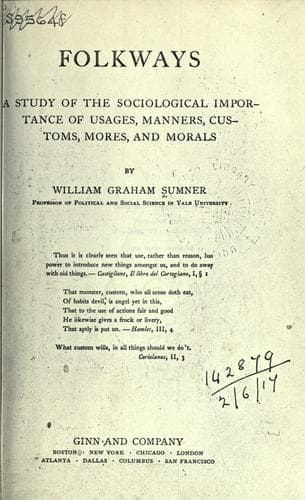
Folkways: A Study of the Sociological Importance of Usages, Manners, Customs, Mores, and MoralsSumner, William Graham
General
Folkways: A Study of the Sociological Importance of Usages, Manners, Customs, Mores, and Morals
Sumner, William Graham
Manners and customs
attention, and appeal to popular weakness and folly; the ways of
journalism; electioneering devices; oratorical and dithyrambic
extravagances in politics; current methods of humbug and
sensationalism,--are not properly part of the mores but symptoms of
them. They are not products of the concurrent and cooperative effort of
all members of the society to live well. They are devices made with
conscious ingenuity to exert suggestion on the minds of others. The
mores are rather the underlying facts in regard to the faiths, notions,
tastes, desires, etc., of that society at that time, to which all these
modes of action appeal and of whose existence they are evidence.
+65. What is goodness or badness of the mores.+ It is most important to
notice that, for the people of a time and place, their own mores are
always good, or rather that for them there can be no question of the
goodness or badness of their mores. The reason is because the standards
of good and right are in the mores. If the life conditions change, the
traditional folkways may produce pain and loss, or fail to produce the
same good as formerly. Then the loss of comfort and ease brings doubt
into the judgment of welfare (causing doubt of the pleasure of the gods,
or of war power, or of health), and thus disturbs the unconscious
philosophy of the mores. Then a later time will pass judgment on the
mores. Another society may also pass judgment on the mores. In our
literary and historical study of the mores we want to get from them
their educational value, which consists in the stimulus or warning as to
what is, in its effects, societally good or bad. This may lead us to
reject or neglect a phenomenon like infanticide, slavery, or witchcraft,
as an old "abuse" and "evil," or to pass by the crusades as a folly
which cannot recur. Such a course would be a great error. Everything in
the mores of a time and place must be regarded as justified with regard
to that time and place. "Good" mores are those which are well adapted to
the situation. "Bad" mores are those which are not so adapted. The mores
are not so stereotyped and changeless as might appear, because they are
forever moving towards more complete adaptation to conditions and
interests, and also towards more complete adjustment to each other.
People in mass have never made or kept up a custom in order to hurt
their own interests. They have made innumerable errors as to what their
interests were and how to satisfy them, but they have always aimed to
serve their interests as well as they could. This gives the standpoint
for the student of the mores. All things in them come before him on the
same plane. They all bring instruction and warning. They all have the
same relation to power and welfare. The mistakes in them are component
parts of them. We do not study them in order to approve some of them
and condemn others. They are all equally worthy of attention from the
fact that they existed and were used. The chief object of study in them
Public-domain text, read in full here on John Shaqi.
Reviews
Reviews
No reviews yet
Be the first to share your thoughts on this work.
Elsewhere in the archive
Join the Discussion
Join the discussion
Sign in to leave a comment or review.
Sign InorCreate an account