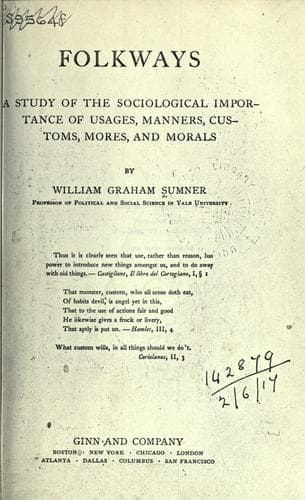
Folkways: A Study of the Sociological Importance of Usages, Manners, Customs, Mores, and MoralsSumner, William Graham
General
Folkways: A Study of the Sociological Importance of Usages, Manners, Customs, Mores, and Morals
Sumner, William Graham
Manners and customs
is their adjustment to interests, their relation to welfare, and their
coordination in a harmonious system of life policy. For the men of the
time there are no "bad" mores. What is traditional and current is the
standard of what ought to be. The masses never raise any question about
such things. If a few raise doubts and questions, this proves that the
folkways have already begun to lose firmness and the regulative element
in the mores has begun to lose authority. This indicates that the
folkways are on their way to a new adjustment. The extreme of folly,
wickedness, and absurdity in the mores is witch persecutions, but the
best men of the seventeenth century had no doubt that witches existed,
and that they ought to be burned. The religion, statecraft,
jurisprudence, philosophy, and social system of that age all contributed
to maintain that belief. It was rather a culmination than a
contradiction of the current faiths and convictions, just as the dogma
that all men are equal and that one ought to have as much political
power in the state as another was the culmination of the political
dogmatism and social philosophy of the nineteenth century. Hence our
judgments of the good or evil consequences of folkways are to be kept
separate from our study of the historical phenomena of them, and of
their strength and the reasons for it. The judgments have their place in
plans and doctrines for the future, not in a retrospect.
+66. More exact definition of the mores.+ We may now formulate a more
complete definition of the mores. They are the ways of doing things
which are current in a society to satisfy human needs and desires,
together with the faiths, notions, codes, and standards of well living
which inhere in those ways, having a genetic connection with them. By
virtue of the latter element the mores are traits in the specific
character (ethos) of a society or a period. They pervade and control the
ways of thinking in all the exigencies of life, returning from the world
of abstractions to the world of action, to give guidance and to win
revivification. "The mores [_Sitten_] are, before any beginning of
reflection, the regulators of the political, social, and religious
behavior of the individual. Conscious reflection is the worst enemy of
the mores, because mores begin unconsciously and pursue unconscious
purposes, which are recognized by reflection often only after long and
circuitous processes, and because their expediency often depends on the
assumption that they will have general acceptance and currency,
uninterfered with by reflection."[77] "The mores are usage in any group,
in so far as it, on the one hand, is not the expression or fulfillment
of an absolute natural necessity [e.g. eating or sleeping], and, on the
other hand, is independent of the arbitrary will of the individual, and
is generally accepted as good and proper, appropriate and worthy."[78]
Public-domain text, read in full here on John Shaqi.
Reviews
Reviews
No reviews yet
Be the first to share your thoughts on this work.
Elsewhere in the archive
Join the Discussion
Join the discussion
Sign in to leave a comment or review.
Sign InorCreate an account