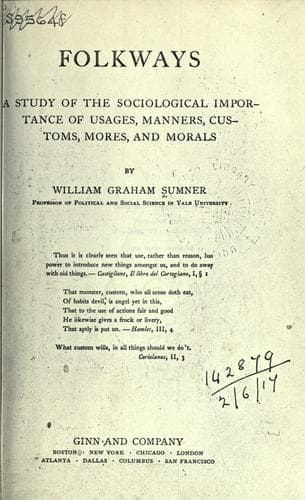
Folkways: A Study of the Sociological Importance of Usages, Manners, Customs, Mores, and MoralsSumner, William Graham
General
Folkways: A Study of the Sociological Importance of Usages, Manners, Customs, Mores, and Morals
Sumner, William Graham
Manners and customs
+71. Force in the folkways.+ Here we notice also the intervention of
force. There is always a large element of force in the folkways. It
constitutes another modification of the theory of the folkways as
expedient devices, developed in experience, to meet the exigencies of
life. The organization of society under chiefs and medicine men greatly
increased the power of the society to serve its own interests. The same
is true of higher political organizations. If Gian Galeazzo Visconti or
Cesare Borgia could have united Italy into a despotic state, it is an
admissible opinion that the history of the peninsula in the following
four or five hundred years would have been happy and prosperous, and
that, at the present time, it would have had the same political system
which it has now. However, chiefs, kings, priests, warriors, statesmen,
and other functionaries have put their own interests in the place of
group interests, and have used the authority they possessed to force the
societal organization to work and fight for their interests. The force
is that of the society itself. It is directed by the ruling class or
persons. The force enters into the mores and becomes a component in
them. Despotism is in the mores of negro tribes, and of all Mohammedan
peoples. There is an element of force in all forms of property,
marriage, and religion. Slavery, however, is the grandest case of force
in the mores, employed to make some serve the interests of others, in
the societal organization. The historical classes, having selected the
group purposes and decided the group policy, use the force of the
society itself to coerce all to acquiesce and to work and fight in the
determined way without regard to their individual interests. This they
do by means of discipline and ritual. In different kinds of mores the
force is screened by different devices. It is always present, and
brutal, cruel force has entered largely into the development of all our
mores, even those which we think most noble and excellent.
Public-domain text, read in full here on John Shaqi.
Reviews
Reviews
No reviews yet
Be the first to share your thoughts on this work.
Elsewhere in the archive
Join the Discussion
Join the discussion
Sign in to leave a comment or review.
Sign InorCreate an account