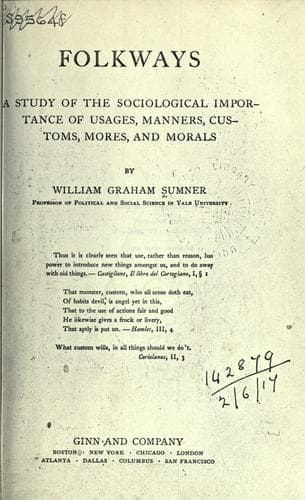
Folkways: A Study of the Sociological Importance of Usages, Manners, Customs, Mores, and MoralsSumner, William Graham
General
Folkways: A Study of the Sociological Importance of Usages, Manners, Customs, Mores, and Morals
Sumner, William Graham
Manners and customs
+72. Might and right.+ Modern civilized states of the best form are
often called jural states because the concept of rights enters so
largely into all their constitutions and regulations. Our political
philosophy centers around that concept, and all our social discussions
fall into the form of propositions and disputes about rights. The
history of the dogma of rights has been such that rights have been
believed to be self-evident and self-existent, and as having prevailed
especially in primitive society. Rights are also regarded as the
opposite of force. These notions only prove the antagonism between our
mores and those of earlier generations. In fact, it is a characteristic
of our mores that the form of our thinking about all points of political
philosophy is set for us by the concept of rights. Nothing but might has
ever made right, and if we include in might (as we ought to) elections
and the decisions of courts, nothing but might makes right now. We must
distinguish between the anterior and the posterior view of the matter in
question. If we are about to take some action, and are debating the
right of it, the might which can be brought to support one view of it
has nothing to do with the right of it. If a thing has been done and is
established by force (that is, no force can reverse it), it is right in
the only sense we know, and rights will follow from it which are not
vitiated at all by the force in it. There would be no security at all
for rights if this were not so. We find men and parties protesting,
declaiming, complaining of what is done, and which they say is not
"right," but only force. An election decides that those shall have power
who will execute an act of policy. The defeated party denounces the
wrong and wickedness of the act. It is done. It may be a war, a
conquest, a spoliation; every one must help to do it by paying taxes and
doing military service or other duty which may be demanded of him. The
decision of a lawsuit leaves one party protesting and complaining. He
always speaks of "right" and "rights." He is forced to acquiesce. The
result is right in the only sense which is real and true. It is more to
the purpose to note that an indefinite series of consequences follow,
and that they create or condition rights which are real and just. Many
persons now argue against property that it began in force and therefore
has no existence in right and justice. They might say the same of
marriage or religion. Some do say the same of the state. The war of the
United States with Mexico in 1845 is now generally regarded as
unjustified. That cannot affect the rights of all kinds which have been
contracted in the territory then ceded by Mexico or under the status
created on the land obtained by the treaty of peace with that country.
The whole history of mankind is a series of acts which are open to
doubt, dispute, and criticism, as to their right and justice, but all
Public-domain text, read in full here on John Shaqi.
Reviews
Reviews
No reviews yet
Be the first to share your thoughts on this work.
Elsewhere in the archive
Join the Discussion
Join the discussion
Sign in to leave a comment or review.
Sign InorCreate an account