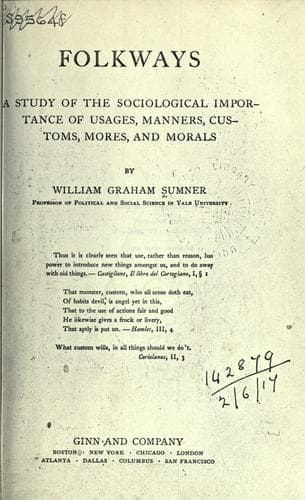
Folkways: A Study of the Sociological Importance of Usages, Manners, Customs, Mores, and MoralsSumner, William Graham
General
Folkways: A Study of the Sociological Importance of Usages, Manners, Customs, Mores, and Morals
Sumner, William Graham
Manners and customs
The law
defines it and gives sanctions to it, but the law always expresses the
mores. A man and a woman make a contract to enter into it. The mode of
entering into it (wedding) is fixed by custom. The law only ratifies it.
No man and woman can by contract make wedlock different for themselves
from the status defined by law, so far as social rights and duties are
concerned. The same conception of marriage as a status in the mores is
injured by the intervention of the ecclesiastical and civil formalities
connected with it. An individual is born into a kin group, a tribe, a
nation, or a state, and he has a status accordingly which determines
rights and duties for him. Civil liberty must be defined in accordance
with this fact; not outside of it, or according to vague metaphysical
abstractions above it. The body of the folkways constitutes a societal
environment. Every one born into it must enter into relations of give
and take with it. He is subjected to influences from it, and it is one
of the life conditions under which he must work out his career of
self-realization. Whatever liberty may be taken to mean, it is certain
that liberty never can mean emancipation from the influence of the
societal environment, or of the mores into which one was born.
+74. Conventionalization.+ If traditional folkways are subjected to
rational or ethical examination they are no longer naive and
unconscious. It may then be found that they are gross, absurd, or
inexpedient. They may still be preserved by conventionalization.
Conventionalization creates a set of conditions under which a thing may
be tolerated which would otherwise be disapproved and tabooed. The
special conditions may be created in fact, or they may be only a fiction
which all agree to respect and to treat as true. When children, in play,
"make believe" that something exists, or exists in a certain way, they
employ conventionalization. Special conditions are created in fact when
some fact is regarded as making the usual taboo inoperative. Such is the
case with all archaic usages which are perpetuated on account of their
antiquity, although they are not accordant with modern standards. The
language of Shakespeare and the Bible contains words which are now
tabooed. In this case, as in very many others, the conventionalization
consists in ignoring the violation of current standards of propriety.
Natural functions and toilet operations are put under conventionalization,
even in low civilization. The conventionalization consists in ignoring
breaches of the ordinary taboo. On account of accidents which may occur,
wellbred people are always ready to apply conventionalization to mishaps
of speech, dress, manner, etc. In fairy stories, fables, romances, and
dramas all are expected to comply with certain conventional understandings
without which the entertainment is impossible; for instance, when beasts
are supposed to speak. In the mythologies this kind of conventionalization
was essential.
Public-domain text, read in full here on John Shaqi.
Reviews
Reviews
No reviews yet
Be the first to share your thoughts on this work.
Elsewhere in the archive
Join the Discussion
Join the discussion
Sign in to leave a comment or review.
Sign InorCreate an account