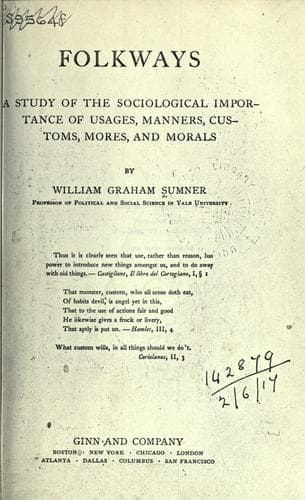
Folkways: A Study of the Sociological Importance of Usages, Manners, Customs, Mores, and MoralsSumner, William Graham
General
Folkways: A Study of the Sociological Importance of Usages, Manners, Customs, Mores, and Morals
Sumner, William Graham
Manners and customs
subsequent history has been forced to take up the consequences of those
acts and go on. The disputants about "rights" often lose sight of the
fact that the world has to go on day by day and dispute must end. It
always ends in force. The end always leaves some complaining in terms of
right and rights. They are overborne by force of some kind. Therefore
might has made all the right which ever has existed or exists now. If it
is proposed to reverse, reform, or change anything which ever was done
because we now think that it was wrong, that is a new question and a new
case, in which the anterior view alone is in place. It is for the new
and future cases that we study historical cases and form judgments on
them which will enable us to act more wisely. If we recognize the great
extent to which force now enters into all which happens in society, we
shall cease to be shocked to learn the extent to which it has been
active in the entire history of civilization. The habit of using jural
concepts, which is now so characteristic of our mores, leads us into
vague and impossible dreams of social affairs, in which metaphysical
concepts are supposed to realize themselves, or are assumed to be real.
+73. Status in the folkways.+ If now we form a conception of the
folkways as a great mass of usages, of all degrees of importance,
covering all the interests of life, constituting an outfit of
instruction for the young, embodying a life policy, forming character,
containing a world philosophy, albeit most vague and unformulated, and
sanctioned by ghost fear so that variation is impossible, we see with
what coercive and inhibitive force the folkways have always grasped the
members of a society. The folkways create status. Membership in the
group, kin, family, neighborhood, rank, or class are cases of status.
The rights and duties of every man and woman were defined by status. No
one could choose whether he would enter into the status or not. For
instance, at puberty every one was married. What marriage meant, and
what a husband or wife was (the rights and duties of each), were fixed
by status. No one could alter the customary relations. Status, as
distinguished from institutions and contract, is a direct product of the
mores. Each case of status is a nucleus of leading interest with the
folkways which cluster around it. Status is determined by birth.
Therefore it is a help and a hindrance, but it is not liberty. In modern
times status has become unpopular and our mores have grown into the
forms of contract under liberty. The conception of status has been lost
by the masses in modern civilized states. Nevertheless we live under
status which has been defined and guaranteed by law and institutions,
and it would be a great gain to recognize and appreciate the element of
status which historically underlies the positive institutions and which
is still subject to the action of the mores. Marriage (matrimony or
wedlock) is a status. It is really controlled by the mores.
Public-domain text, read in full here on John Shaqi.
Reviews
Reviews
No reviews yet
Be the first to share your thoughts on this work.
Elsewhere in the archive
Join the Discussion
Join the discussion
Sign in to leave a comment or review.
Sign InorCreate an account